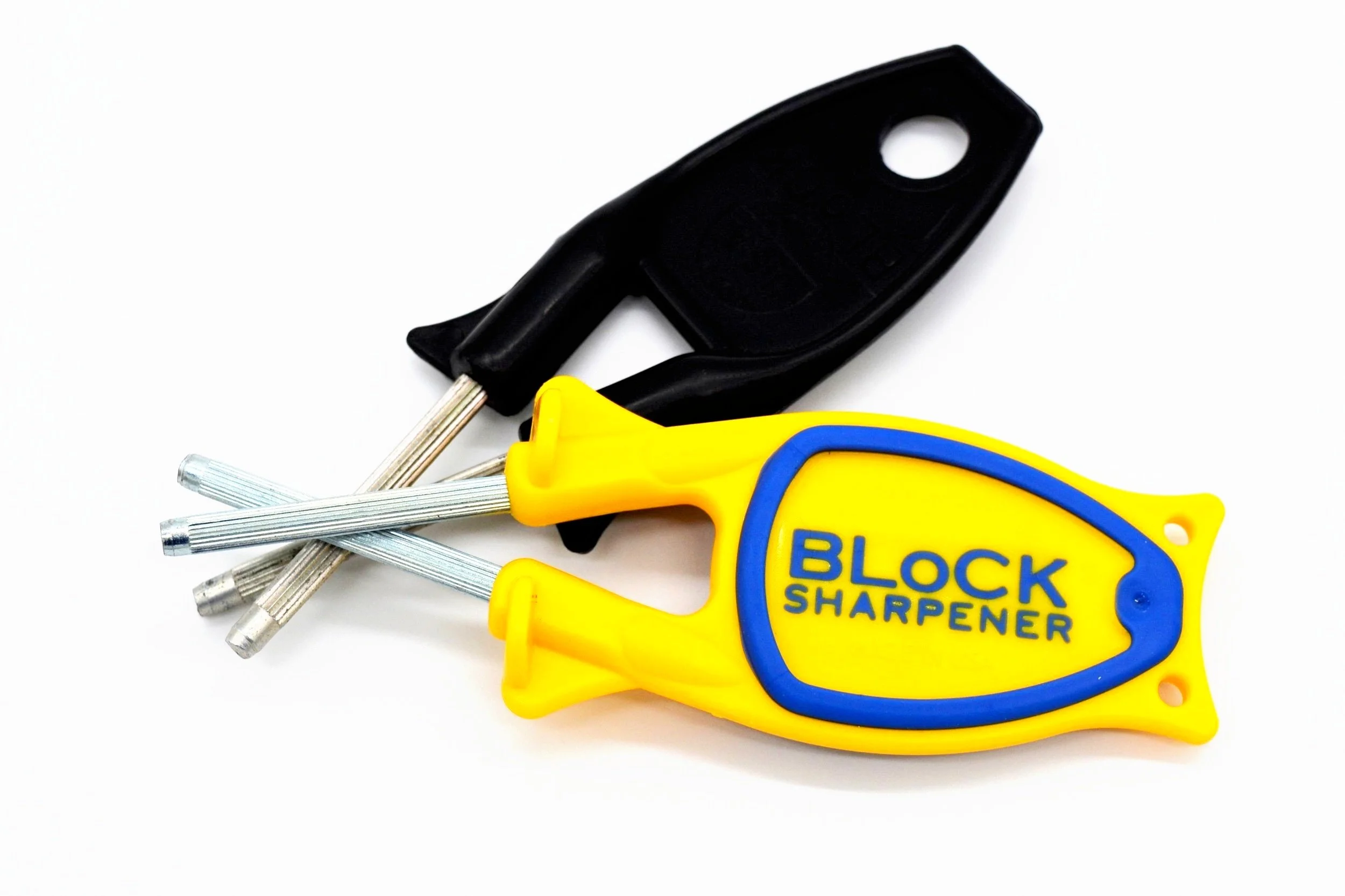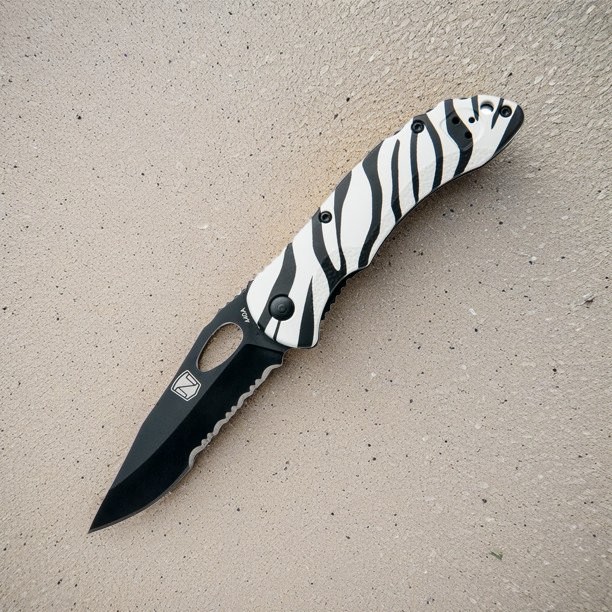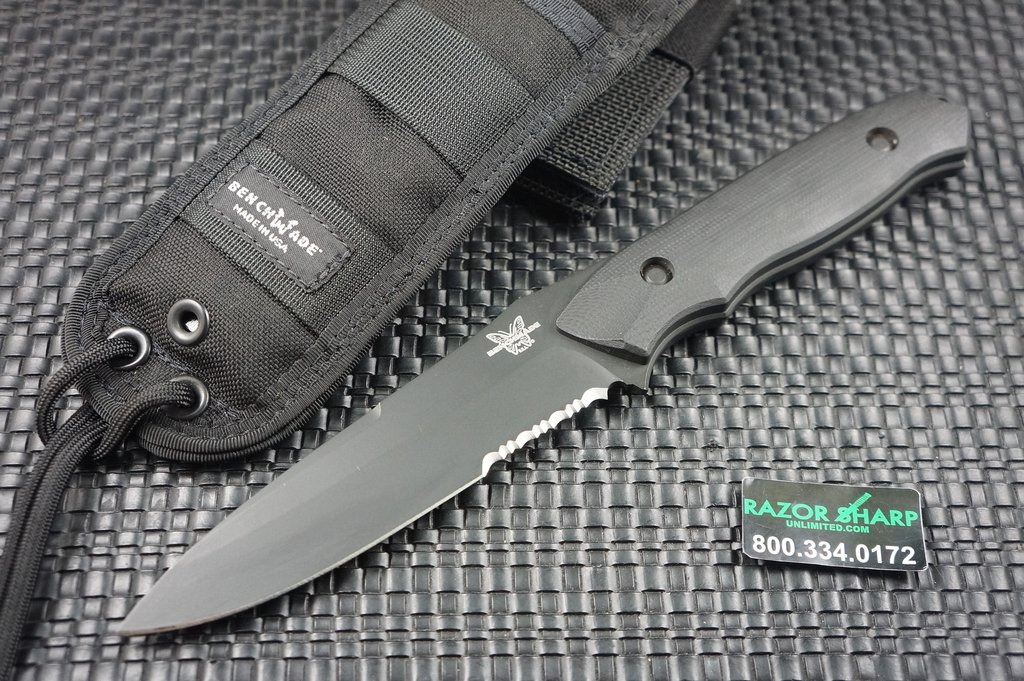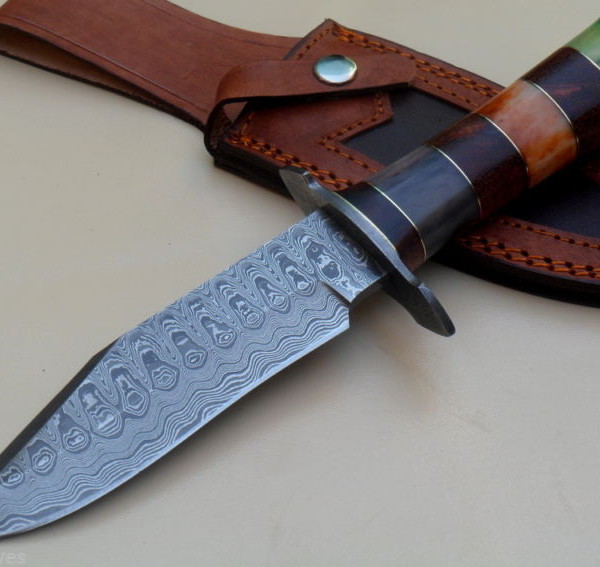
Block sharpener

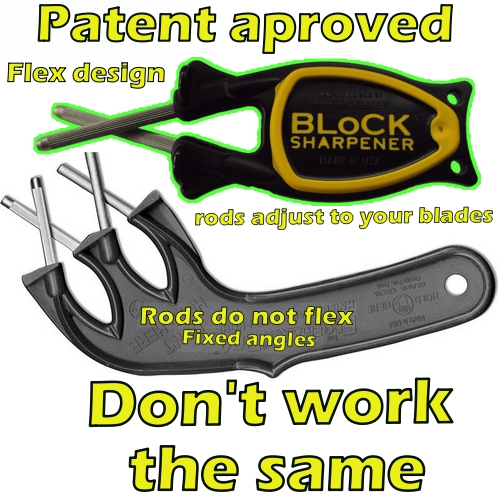
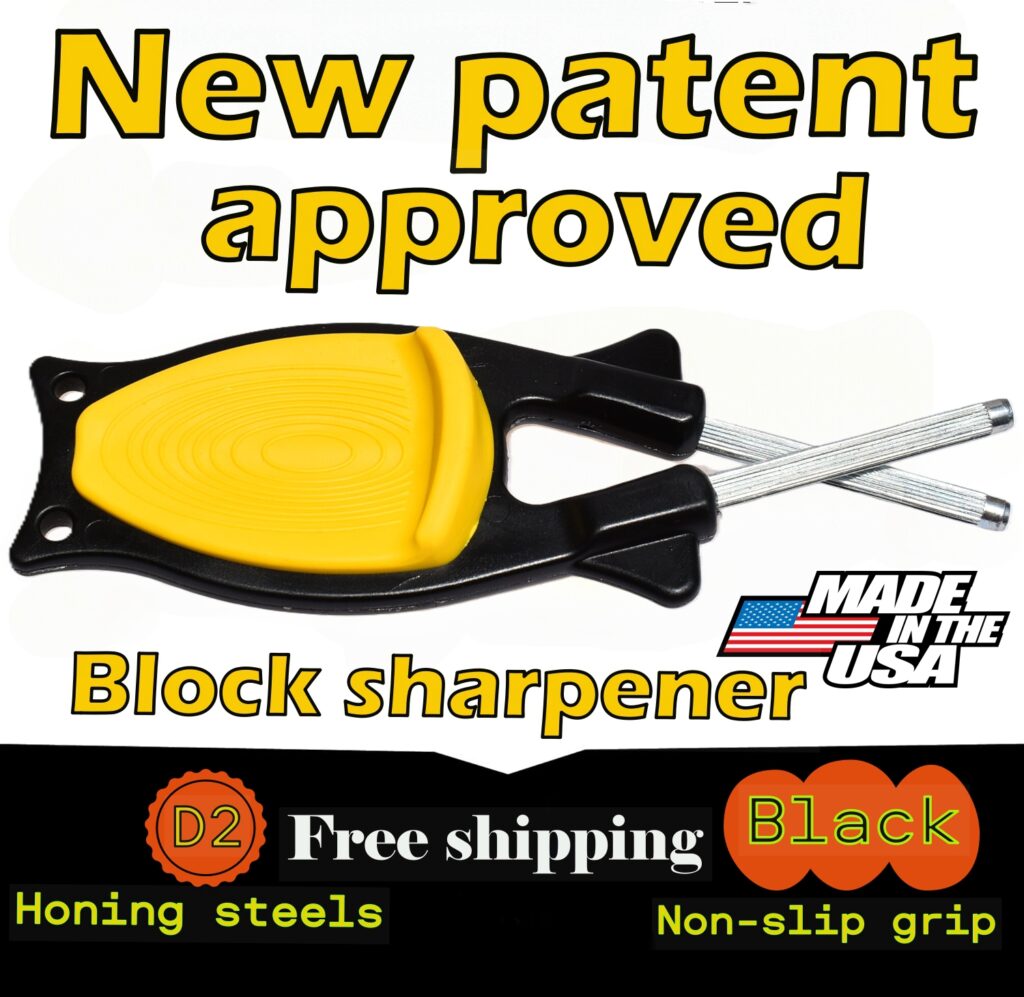
New patent approved Block sharpener.

Made in USA-original 1969- new modle 2014

Master the Edge: Why the Block Sharpener is the Ultimate All-in-One Tool
A knife is only as good as its edge. Whether you’re cutting rope at a campsite, prepping a family meal, or using specialized tools in the field, a dull blade isn’t just frustrating—it’s dangerous. That’s why the Block Sharpener has become a staple for everyone from professional chefs to outdoor enthusiasts. It isn’t just another sharpener; it’s a precision honing system designed to keep your tools ready for any task.
The Magic of the Flexible Design
The secret to the Block Sharpener’s success lies in its unique flexible handle. Unlike rigid, “one-size-fits-all” sharpeners that can grind away your blade’s steel, the Block’s honing rods automatically adjust to the specific angle of your knife.
This adaptive technology makes it incredibly versatile:
  • Kitchen Essentials: Perfect for standard chef’s knives and paring knives.
  • Specialized Blades: Easily handles serrated bread knives and even electric carving knives.
  • Outdoor Gear: Realigns heavy-duty hunting knives and pocket folders in seconds.
Precision Control Anywhere, Anytime
Safety and stability are paramount when working with sharp edges. The Block Sharpener is engineered with a dual-grip system that sets it apart from the competition:
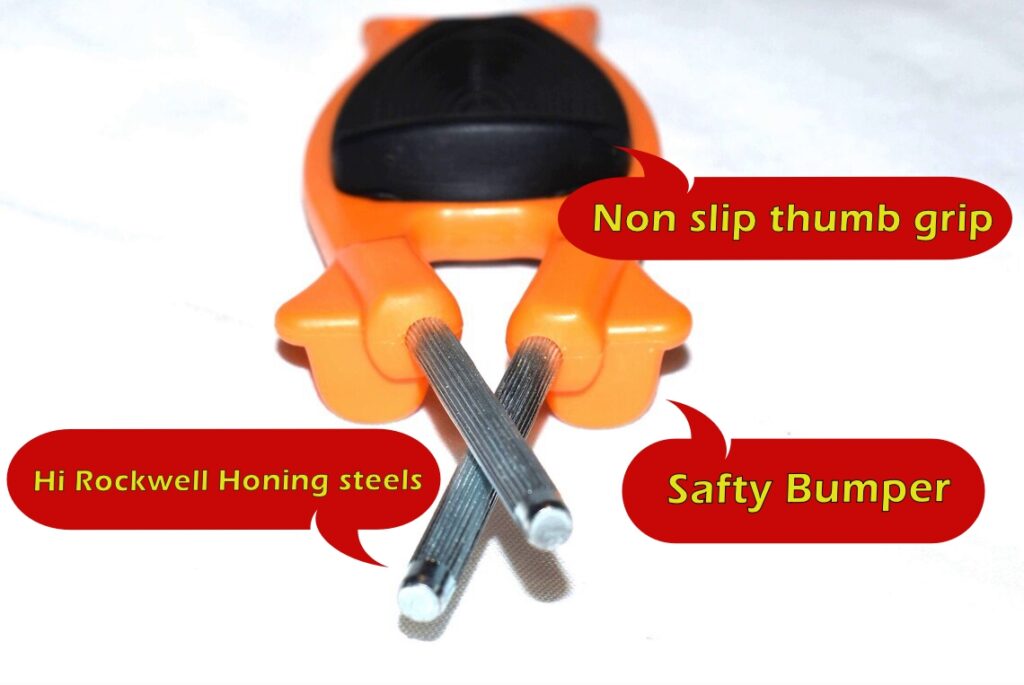
  • Non-Slip Base: Provides a rock-solid foundation when sharpening on a table or countertop.
  • Ergonomic Thumb Grip: Located on the top of the handle, this specialized grip offers maximum control and stability.
This thumb grip is a game-changer for handheld sharpening. If you’re out in the woods or on a boat without a flat surface, the thumb grip allows you to maintain a secure, “locked-in” hold. This extra leverage is especially helpful when sharpening uniquely shaped blades or large tools where precision movement is key.
Why Choose the Block?
The Block Sharpener doesn’t just sharpen; it realigns your blade to its original factory edge. It’s simple enough for a novice to use but effective enough for a seasoned pro. Lightweight, portable, and built to last, it’s the only tool you’ll need to ensure your knives stay as sharp as the day you bought them.
The Verdict: If you want a sharpener that is as versatile as your knife collection and safe enough to use in any environment, the Block Sharpener is the clear winner

Add Your Heading Text Here

Block sharpener
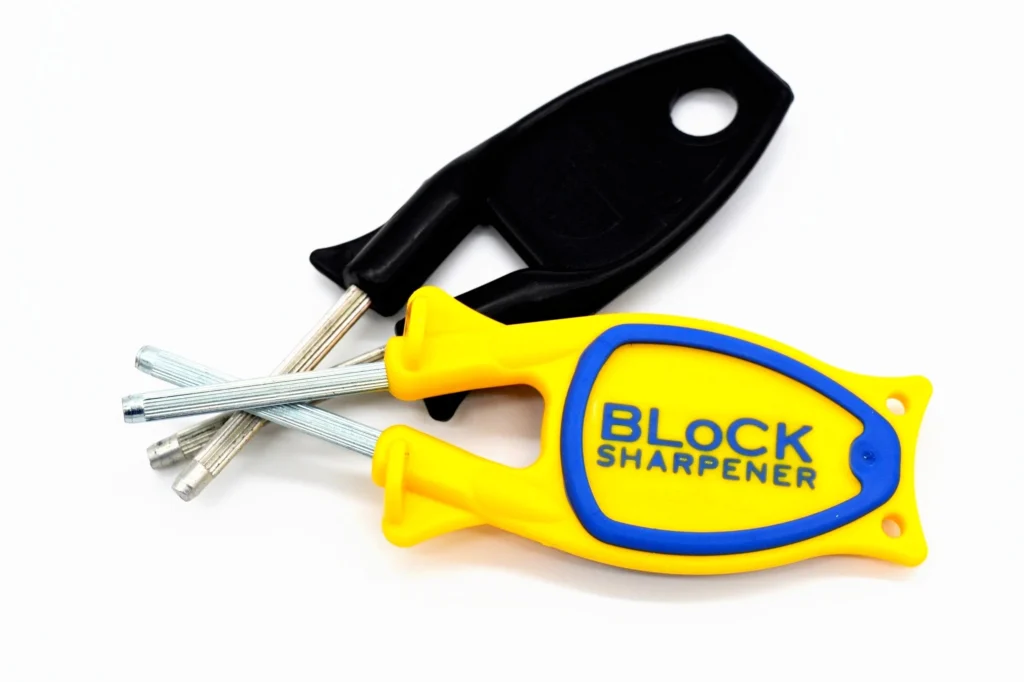
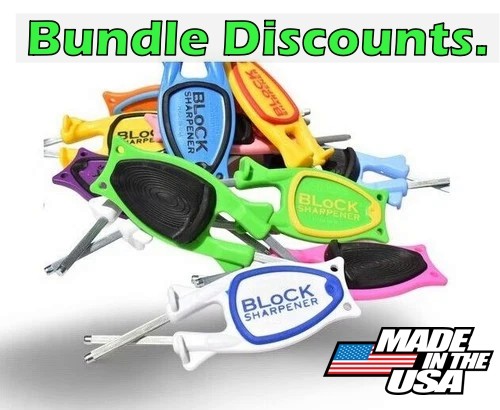
Our original sharpener honing steels were crafted in a gold hue from heat-treated 1018 steel. These robust rods remain integral to the original Block sharpeners, established in 1969. Our latest iteration of Block sharpeners is constructed from durable polyurethane plastic reinforced with fiberglass, showcasing a non-slip grip on both sides, highlighted in yellow. In 2019, we elevated our honing rods to D2 tool steel, enhancing their heat-treated properties for superior hardness, ensuring they effectively hone even the toughest blades. Consequently, sharpening harder steels is now achievable. The redesigned rods are presented in silver.
Knife sharpeners
Don't be fooled by look-alikes or similar designs that might seem appealing. Block sharpeners are patented sharpeners specifically engineered to realign and hone blades with precision and care. Unlike generic alternatives, Block sharpeners' unique honing rods are designed to seamlessly adjust to the contours of your blades' edges, ensuring an optimal sharpening experience every time. We utilize the hardest and most durable steels in our construction to guarantee a long life, so you can confidently sharpen even the most challenging and difficult blades without worry.
Block sharpener
Knife sharpener

Knife Edge Styles

Every knife blade is ground uniquely to form a sharpened edge. Each side of the blade that has honed an edge is referred to as a bevel. If you look closely at the blade of your kitchen knives, you should notice a part at the very edge that angles more steeply–this is the bevel.

Kitchen knives are easily one of the most commonly used tools on the planet. They are simple yet used for a variety of culinary tasks daily. But the very cutting edge that we rely on — and the source of the knife’s power–is nearly invisible to the unaided eye, a reason why we seem to take these trusty instruments for granted.

The majority of kitchen knives are flat ground, meaning the blade begins to taper from the spine to the edge. However, knife edges come in a variety of styles and differences in the way the blade is ground to make it sharp. If you look closely at the blade of your kitchen knives, you should notice a part at the very edge that angles more steeply–this is the primary bevel. Most of the time people refer to the Edge Angle—see the image below. Typically, this is about 15º to 25º for kitchen knives. 


Bloc:k Sharpener One Tool for Every Edge Geometry

Understanding your knife’s edge is the first step to maintaining it. While different manufacturers use various grinds for specific tasks, the Block Sharpener is engineered with a patented flex design that adapts to almost all of them, ensuring you don’t ruin a specialized blade with a “one-size-fits-all” approach.
1. V-Edge (The Kitchen Standard)
    • The Edge: A straight slant from spine to edge.
    • Block Performance: This is the “bread and butter” for a Block Sharpener. Because V-edges prioritize a fine, sharp point over durability, the D2 rods hone the edge back to a razor finish without removing the precious metal needed to keep that V-shape intact.

2. Double Bevel / Compound Edge (The Pro’s Choice)
    • The Edge: A “V on a V” designed for a mix of extreme sharpness and extra durability.
    • Block Performance: This is a favorite because the flexible rods naturally “find” the primary cutting bevel. Instead of fighting the secondary relief angle, the Block Sharpener focuses its honing energy right at the apex, keeping the edge strong and resistant to rolling.

3. Chisel Edge (Japanese Specialty)
    • The Edge: Ground on one side (20º–25º), flat on the other. Common on Sushi knives.
    • Block Performance: To sharpen a chisel edge, you simply tilt the knife slightly so only the beveled side contacts the rods. The Block’s ability to “squeeze” the blade allows you to maintain that acute, delicate angle without accidentally creating a bevel on the flat side.

4. Convex Edge (The “Airplane Wing”)
    • The Edge: Outward arcs that put more steel behind the point for maximum strength.
    • Block Performance: Convex edges are notoriously difficult to sharpen at home and often get ruined by being turned into V-edges. However, the flexing action of the Block Sharpener follows the curve of the arc, maintaining that sophisticated “wing” shape rather than shaving it flat.

5. Hollow Edge (Concave / Hunting Style)
    • The Edge: Curves inward for a wicked-sharp but thin edge.
    • Block Performance: Common in hunting and survival knives, these edges are delicate. The Block Sharpener is ideal here because it provides honing pressure rather than aggressive grinding, realigning the thin edge without making it even more susceptible to damage.

6. Serrated Edge (The Bread & Pocket Knife Essential)
    • The Edge: Mini-arches or “teeth” ground on one side.
    • Block Performance: This is where the Block Sharpener truly shines. Its rounded, flexible rods reach deep into the arches of the serrations. By using a light “rocking” motion, you can hone the teeth of any serrated knife—from a budget bread knife to a high-end tactical blade—without flattening the points.


Pro Tip: No matter the grind, the secret to the Block Sharpener is its American-made D2 Tool Steel. It’s harder than the steel in your knife, meaning it does the work of realigning the edge so you don’t have t


different Types of steels and what's makes them different

There are literally thousands of types of steel. Among them, the most common are carbon steels, alloy steels, tool steels, and stainless steels. Each of these types of steel has a designation system that gives them a specific number. I will give you one example: In the SAE (Society of Automotive Engineers) designation system, carbon steel and alloy steel are designated by a four-digit number, where the first digit indicates the main element, the second digit indicates the secondary element, and the last two digits indicate the amount of carbon, in hundredths of a percent by weight. So, this means that 1095 steel would be .95% carbon. In addition, in the SAE system any steel starting with a letter is classified as tool steel.

Plain carbon steels are steels that contain iron, carbon, and a small amount of manganese. In contrast, alloy steels have a specified composition and contain certain percentages of vanadium or molybdenum, and they also typically have a larger amount of manganese. Tool steel contains tungsten, molybdenum, and other alloying elements.
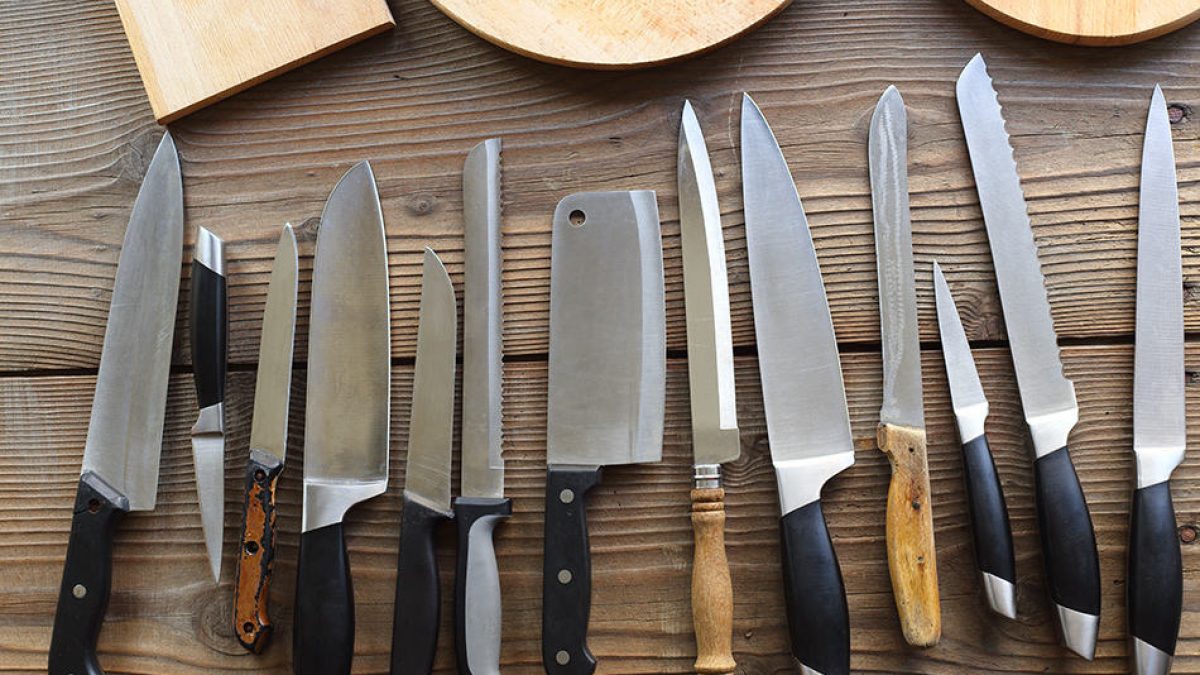
Block sharpeners are the perfect sharpener for keeping knives sharp and ready to use.

STEELS USED IN MAKING KNIVES

Explore the distinctions among various steel types utilized in knife blade production.

Whether you’ve been collecting knives for years or are just getting started, you’ve probably wondered about the differences between the many types of steel used in knife blades. With so many options out there, it’s natural to ask yourself which steel is the best. This guide will help you understand which steels work best for different purposes, making it easier to choose the right one for your needs.

All that is needed to make basic steel is a combination of iron and carbon. However, over time it was found that adding different elements to this basic steel substance can increase its toughness or hardness. These added elements account for what is the major difference of most types of steel in blades. It was quickly discovered that there are advantages and disadvantages to each added element. For example, a certain alloy might make a blade harder. The harder the steel, the longer it will hold its edge (and that means less frequent sharpening), which is great! However, if you harden the blade, you also make the blade less tough, which means the blade is less resistant to shock and impact (not such a good thing). Unfortunately, a blade cannot be both harder, and tougher; as you add toughness, you make the blade less hard and vice versa. Since not all of us have the basic training of a materials scientist, here are a few key differences in steel types that will help you decide what type of blade is best for you. Block sharpeners have been field tested on all these types of knives.
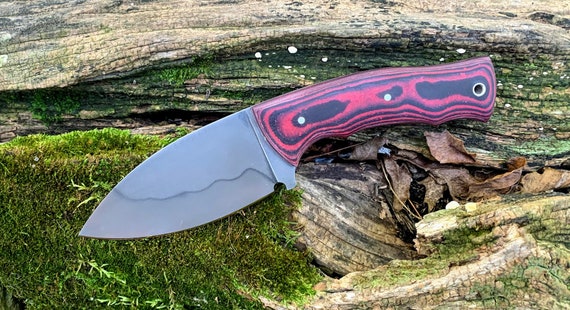
STEELS USED IN MAKING KNIVES

Plain Carbon Steels

The Block Sharpener is specifically engineered to handle plain carbon steels like the 10XX series because its honing rods are harder than the steel itself, allowing them to realign the edge without tearing the metal. 
Why Block Sharpeners Work Well on 10XX Steels
  • Hardness Match: These sharpeners use heat-treated D2 Tool Steel rods with a Rockwell hardness over 69. Standard 1095 steel is typically heat-treated to a “sweet spot” of 57–58 Rockwell. Because the rods are significantly harder than the blade, they can easily push the steel back into alignment.
  • Honing Over Grinding: Carbon steels are prized for their “easy to sharpen” nature, but they can be worn away quickly by aggressive grinders. The Block Sharpener focuses on honing—realigning the microscopic “teeth” of the edge—which preserves the life of the blade while restoring razor sharpness.
  • Adaptive Flex: Plain carbon steel blades come in many forms, from thick survival knives to thin kitchen slicers. The Block Sharpener’s patented flex design squeezes the edge, automatically adjusting to the unique factory bevel of your specific tool. 
1095 vs. 1045 Performance
Steel Type 1 Carbon Content Characteristics Sharpening Detail
1095 High Carbon 0.95% Highly wear-resistant, holds a superior edge, but can be brittle. Responds exceptionally well to the Block Sharpener’s D2 rods, taking a very fine, razor-like edge quickly.
1045 Medium Carbon 0.45% Tough and resilient but softer; won’t hold an edge as long. Easier to work with but requires more frequent touch-ups. The sharpener realigns its softer edge with very light pressure.
Maintenance for Carbon Steels
The primary drawback of 10XX steels is their vulnerability to rust (oxidation). To keep your edge in peak condition after using your Block Sharpener
  1. Clean & Dry: Always rinse and thoroughly dry the blade immediately after use.
  2. Oil the Edge: Apply a light coat of food-grade mineral oil (for kitchen knives) or gun oil (for outdoor knives) to protect the exposed steel on the freshly sharpened edge.
  3. Mind the Coating: Many 1095 survival knives have a protective coating. The Block Sharpener is ideal here because it only contacts the very edge, preventing unsightly scratches on the rest of the blade’s finish.
STEELS USED IN MAKING KNIVES

Tool Steels - Sharpens well with a block sharpener and is easy to maintain, but can be tough to work with if it becomes too dull.

The Block Sharpener is an ideal match for 52100 High Carbon Tool Steel because it bridges the gap between the steel’s extreme hardness and its need for a refined, precise edge.
Why the Block Sharpener Excels with 52100
  • Managing High Carbon Density: With carbon levels up to 1.10%, 52100 is exceptionally dense and wear-resistant. The D2 Tool Steel rods in the Block Sharpener (hardened to 69+ Rockwell) are one of the few portable materials hard enough to effectively “bite” into 52100 and realign the edge without the rods themselves being worn down.
  • Refining the “Keen Edge”: 52100 is famous for its ability to take a very “fine” edge (meaning it can be sharpened to a very thin, sharp point). The flex design of the Block Sharpener ensures that as you pull the blade through, the rods apply consistent, even pressure along the entire bevel, polishing that fine edge to a razor finish.
  • Preserving Blade Geometry: Because 52100 is often used in high-performance hunting and custom forged knives, maintaining the specific factory or maker’s angle is vital. The Block Sharpener automatically adjusts to the knife’s existing angle, so you don’t risk rounding off the precise edge that makes 52100 so effective in the first place.
Performance Breakdown for 52100 Steel
Feature Performance with Block Sharpener
Edge Creation Rapid; the rods efficiently handle the 1.10% carbon density.
Edge Polish High; 52100 responds well to the honing action, resulting in a “sticky sharp” feel.
User Effort Low; the steel’s fine grain structure makes it very “responsive” to the sharpener.
Crucial Maintenance Tip for 52100
As you noted, the lower chromium content makes this steel a “rust magnet.” When you sharpen 52100, you are exposing fresh, reactive steel at the very edge.
  • Immediate Action: After using your Block Sharpener, always wipe the blade with a silicone cloth or a light coat of mineral oil.
  • Rod Care: Occasionally wipe down the D2 rods of your sharpener with a dry cloth to ensure no moisture from a carbon steel blade stays on the tool, which prevents “cross-contamination” of rust.

Sharpening A2 steel- Keep up with or is hard to get back.

Sharpening the Combat Legend: A2 Tool Steel and the Block Sharpener
If you own a custom combat knife or a high-end survival tool, there’s a good chance it’s crafted from A2 Tool Steel. Known in the knife world for its incredible “toughness,” A2 is a favorite for blades that need to withstand heavy impact without chipping.
Here is why the Block Sharpener is the essential maintenance tool for this legendary steel.
1. The Toughness Factor
A2 steel is designed to take a beating. While it has slightly less wear resistance than “super steels” like S90V, its carbon content (0.95–1.05%) allows it to take a wicked, aggressive edge.
  • The Block Advantage: Because A2 is so tough, the D2 Tool Steel rods of the Block Sharpener are the perfect match. They are hard enough to realign the A2 edge easily, ensuring that your combat or field knife is back to shaving-sharp in just a few passes.
2. Ease of Sharpening (If You Keep Up!)
A2 is famous for being “user-friendly” on the sharpening bench. It responds quickly to honing, but there is a catch: regular upkeep is key.
  • The Pro Tip: Once an A2 blade becomes extremely dull or sustains edge damage, it becomes significantly harder to restore by hand. The Block Sharpener is designed for “preventative maintenance.” By giving your knife 5–10 light strokes after every use, you keep the edge at its peak and avoid the need for a difficult, time-consuming regrind.
3. Protecting the Low-Chromium Edge
With only about 5% chromium, A2 is not a stainless steel and is highly susceptible to rust. This is why many A2 blades come with a protective coating.
  • The Block Advantage: Conventional sharpeners can scuff or scrape the coating on the face of your custom blade. The Block Sharpener’s patented flex design only contacts the very edge of the bevel. This keeps the protective coating intact on the rest of the blade while ensuring the exposed steel at the cutting edge is polished and sharp.
4. The Perfect “Field” Solution
Because A2 is often used in knives meant for the woods or combat zones, you need a sharpener that is as portable as the knife itself. The Block Sharpener’s non-slip grip and thumb guard allow you to safely touch up your A2 blade in the field—even without a table—so your “tough” steel never loses its “bite.”
The Verdict: A2 steel is a high-performance material that rewards the owner who maintains it. By using the Block Sharpener for regular honing, you ensure your custom combat knife stays sharp, durable, and ready for action.
Would you like to know which oil or wax we recommend to protect that freshly sharpened A2 edge from rust
 
 
STEELS USED IN MAKING KNIVES

Block sharpener-VS-CPM 10V Steel

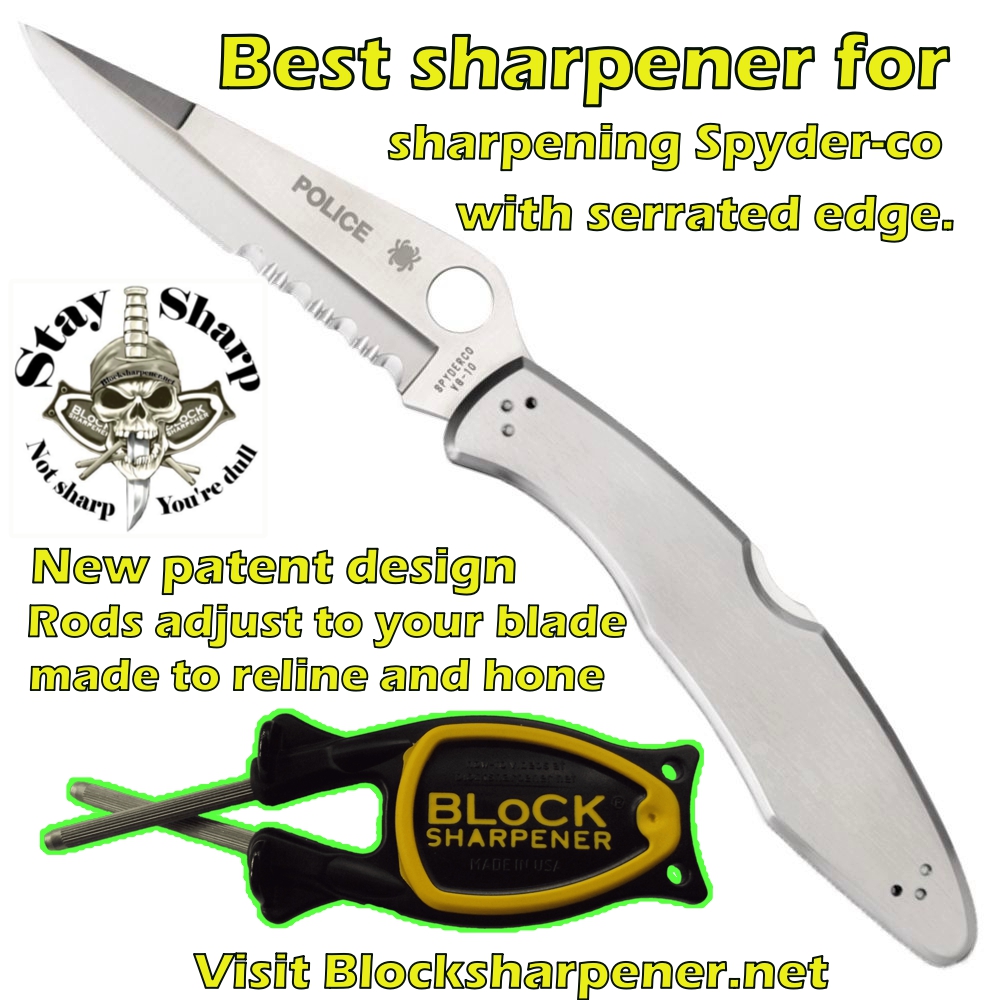
Why the Block Sharpener is the Perfect Match for Spyderco Knives
Spyderco is world-renowned for pushing the boundaries of metallurgy, often being the first to bring “exotic” steels to the everyday carry market. Whether it’s their iconic SpyderEdge serrations or high-performance CPM (Crucible Particle Metallurgy) steels like S30V, Maxamet, or MagnaCut, these blades require a specialized touch to stay sharp.
Here is why the Block Sharpener is the go-to tool for Spyderco enthusiasts:
1. Mastering the “Super Steel” Hardness
Spyderco uses some of the most wear-resistant steels available. Because the Block Sharpener utilizes heat-treated D2 tool steel rods (hardened to a high Rockwell scale), it is one of the few manual tools that can effectively “bite” into these premium alloys. While standard ceramic rods might slide off a hard S30V or S110V blade, the D2 rods successfully realign the edge for a shaving-sharp finish.
2. The Patented Flex Protects Brittle Edges
High-performance steels are often very hard, which can make them brittle. Conventional rigid sharpeners can cause “micro-chipping” if the angle isn’t perfect. The Block Sharpener’s patented flexing action is the solution; the rods “squeeze” and naturally follow the Spyderco factory bevel. This prevents the harsh impact that leads to chipping, delivering a smooth, fine-edge polish instead.
3. Unmatched Performance on the “SpyderEdge”
One of Spyderco’s most famous features is their aggressive serration pattern. Most sharpeners will flatten these teeth, ruining the knife’s cutting power. Because the Block Sharpener’s rods are rounded and flexible, they can reach deep into the scallops of a serrated blade. By using a light “rocking” motion, you can hone each individual tooth of your Spyderco without damaging the unique edge geometry.
4. Safe for Signature Finishes
From satin finishes to black DLC (Diamond-Like Carbon) coatings, Spyderco knives are as much a work of art as they are a tool. The Block Sharpener is designed to only contact the very edge of the bevel. This ensures your blade’s face remains pristine and free of the scratches often caused by whetstones or bulky clamp-and-rod systems.
The Verdict: If you want to maintain the razor-sharp reputation of your Spyderco without the risk of chipping or damaging the blade, the Block Sharpener is the most effective and safest portable tool for the job.
Would you like a quick tip on the “rocking” technique for getting your serrated SpyderEdge back to factory-sharpness?

Made in USA

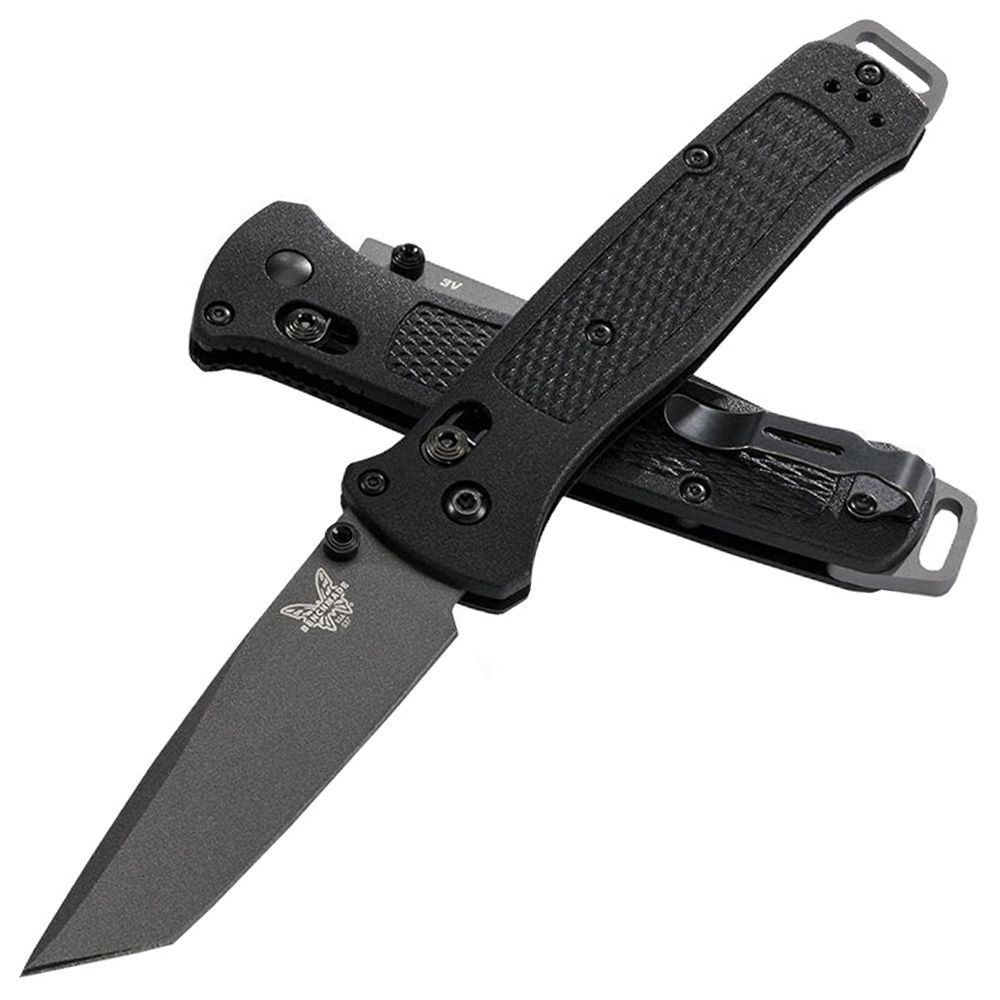
Benchmade knives- VS-(D2,S30V/S90

Why the Block Sharpener is the Ultimate Match for Benchmade “Super Steels”
If you own a Benchmade, you aren’t just carrying a knife; you’re carrying a high-performance tool built with some of the most advanced metallurgy in the world. From the classic 154CM to “super steels” like S30V and S90V, Benchmade selects premium materials that are notoriously difficult to maintain with standard sharpeners.
Here is why the Block Sharpener is widely considered the best choice for these elite blades:
1. It Conquers “Super Steel” Hardness
Benchmade often uses CPM (Crucible Particle Metallurgy) steels like S30V and S90V. These contain high amounts of Vanadium and Carbon, making them incredibly wear-resistant. While ceramic or soft steel rods often slide right over these surfaces, the Block Sharpener uses heat-treated D2 Tool Steel (69+ Rockwell hardness). It is one of the few portable tools hard enough to actually “bite” into and realign these ultra-hard edges.
2. The Patented Flex Protects Your Investment
Benchmade knives come from the factory with a precise edge geometry. A standard “V-slot” sharpener can be too aggressive, forcing a new angle and potentially ruining the blade’s profile. The Block Sharpener features a patented flex design that allows the rods to “squeeze” and follow the existing factory bevel. Whether you are sharpening an Ares in 154CM or a Bugout in S30V, the tool adapts to the knife, not the other way around.
3. Shaving Sharp Performance Across the Board:
  • 154CM: This excellent all-purpose stainless steel responds beautifully to the Block Sharpener, taking a polished, shaving-sharp edge in seconds.
  • S30V & M390: These steels offer superior edge retention but can be a nightmare to sharpen. The Block Sharpener hones them effortlessly, realigning the edge without needing to grind away the expensive material.
  • S90V & CPM-M4: Known for extreme wear resistance, these professional-grade tool steels meet their match with the D2 rods of the Block Sharpener, maintaining that “keen” edge even after heavy use.
4. Safety for Premium Finishes
Many Benchmade knives feature specialized coatings like Cerakote or DLC. Because the Block Sharpener only contacts the very edge of the bevel, it keeps your blade’s face looking brand new and scratch-free, unlike messy stones or bulky clamp systems.
The Verdict: Benchmade chooses the best steel to suit their knife styles, and the Block Sharpener provides the professional-grade honing required to keep those premium alloys performing at their peak. It is the only portable tool that guarantees a shaving-sharp edge on the hardest steels Benchmade has to offer
STEELS USED IN MAKING KNIVES

L6 Steel

L6 Steel: The Saw-Blade Sharpness for Your Kitchen and Field Knives
If you own a knife made from L6 Tool Steel, you’re holding a piece of equipment designed for extreme performance. Historically used for industrial saw blades, L6 is a favorite among custom knife makers because it is incredibly tough, holds a “hungry” edge, and won’t chip under heavy pressure.
Here is why the Block Sharpener is the best tool for maintaining this high-performance cutlery.
1. Why L6 Sharpens “Great”
L6 is a low-alloy tool steel that is remarkably responsive to honing. While some “super steels” can feel like you’re sharpening a piece of glass, L6 has a “bite” to it that allows it to take a razor-sharp edge very quickly.
  • The Block Advantage: The heat-treated D2 rods of the Block Sharpener are significantly harder than L6. This means the sharpener doesn’t just rub against the blade—it actively realigns the steel, bringing back that factory-fresh edge in just 5 to 10 light strokes.
2. Managing the “Non-Stainless” Edge
The biggest trade-off with L6 is its vulnerability to rust and patina. Because it has very little chromium, the steel reacts quickly to moisture, especially on the freshly exposed metal of a sharpened edge.
  • The Pro Tip: Regular maintenance is non-negotiable. The Block Sharpener is perfect for “consistent maintenance” because it’s fast and portable. You can touch up the edge after a day of work and then immediately apply a protective oil to prevent the rust that L6 is prone to.
3. Strength Meets Flexibility
Because L6 is used in saw blades, it’s meant to flex without snapping. Your knife has that same resilient DNA.
  • The Block Advantage: The patented flex design of the Block Sharpener mimics the natural resilience of L6. The rods “squeeze” and follow the original bevel of your knife perfectly. This ensures you aren’t grinding away the premium steel or thinning the blade—you’re simply keeping that world-class edge in alignment.
4. The Choice for Professional Cutlery
Many experts consider L6 one of the best steels for professional-grade cutlery because of its balance of hardness and durability. To keep it performing at that elite level, you need a sharpener that provides a consistent, professional finish without a complicated setup.
The Verdict: L6 steel is a workhorse that rewards the owner who takes care of it. With the Block Sharpener, keeping your L6 knife shaving-sharp and rust-free is easier than ever.
 

M2 Steel

Sharpening M2 High-Speed Steel: Conquering the “Glass” Edge
If you’re working with M2 High-Speed Steel (HSS), you’re dealing with a material designed to cut other metals. With a carbon content of around .85% and incredible heat resistance, M2 is legendary for its edge retention—but it’s also one of the most challenging steels to maintain.
The “Glass” Challenge
Sharpening M2 often feels like moving your knife across a pane of glass. It is exceptionally hard and can be brittle, especially on larger blades. If you let an M2 knife get truly dull, restoring the edge is a massive undertaking. However, if you treat the knife right, it may never actually stay dull.
How to Master M2 with the Block Sharpener:
  • Keep Up, Don’t Catch Up: The secret to M2 is frequent touch-ups. Use your Block Sharpener for “preventative maintenance.” If you keep the edge aligned, the steel is so wear-resistant it can stay razor-sharp almost indefinitely.
  • The Power of Lubrication: Because M2 is so dense, friction can be an issue. Keep your honing rods oiled when working with this steel. This reduces heat and allows the D2 rods to glide more effectively over the hard surface.
  • Firm Pressure: While we usually recommend light strokes for softer steels, M2 requires you to press firmly. You need that extra pressure to allow the D2 rods to “bite” into the heat-resistant surface and realign the edge.
  • Patented Flex Protection: M2 can be brittle under stress. The flexing action of the Block Sharpener is critical here—it “squeezes” the blade to follow the factory bevel perfectly, preventing the harsh, rigid impacts that lead to chipping.
The Verdict: M2 steel is a beast of a material that rewards the disciplined owner. By using firm pressure and keeping your rods oiled, the Block Sharpener will help you maintain a professional, high-performance edge on even the hardest high-speed steels.
Would you like to know which specific oil works best on the D2 rods to get that perfect glide on M2 steel?
STEELS USED IN MAKING KNIVES

O1 Steel

problem is that it rusts rather quickly if it isn’t maintained. It has a carbon content range of .85-1.00%. Popular O1 Knives: Block sharpener can sharpen it very sharp, Oil the honing rods.
Block Sharpener vs. O1 Tool Steel: The Ultimate Honing Matchup
If you’re a fan of custom bushcraft knives or classic shop tools, you’ve likely encountered O1 Tool Steel. It is a “high-carbon” favorite (with 0.85–1.00% carbon) known for its incredible hardness and its ability to take a screaming-sharp edge.
However, O1 is a “non-stainless” steel, meaning it requires a specific maintenance routine to perform at its peak. Here is how the Block Sharpener handles this carbon steel legend:
  • Effortless Sharpening: Because O1 is a relatively “clean” and fine-grained steel, it responds exceptionally well to the Block Sharpener. You can achieve a shaving-sharp edge in just a few passes because the D2 rods easily realign the dense carbon structure.
  • The “Rust” Reality: The major trade-off with O1 is how fast it can rust. Even moisture in the air can cause pitting if the blade isn’t maintained. The Block Sharpener is the perfect tool for consistent upkeep, allowing you to touch up the edge and immediately re-oil the blade before oxidation sets in.
  • Pro Tip—Oil the Rods: When sharpening O1, we recommend oiling your honing rods. This provides a smoother glide, reduces friction, and helps protect the freshly exposed carbon steel edge from moisture during the sharpening process.
  • Superior Edge Retention: O1 is prized for holding its sharpness through heavy wood carving or shop work. By using the patented flex rods, you ensure you are honing the original bevel and keeping that hard-earned edge in perfect alignment.
The Verdict: O1 steel is a “purist’s steel” that rewards regular care. With the Block Sharpener and a little oil, you’ll have a blade that stays sharper, longer, and resists the rust that plagues neglected carbon steel.
 

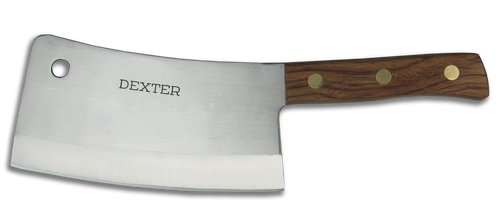
The 400 SERIES knives can all be easily. = Sharpening Cleaver knife Click Image

Whether you’re in a high-volume butcher shop or a busy home kitchen, 420 and 440 series stainless steels are the backbone of many meat cleavers. Because these tools face high-impact work—hacking through bone, cartilage, and heavy proteins—the Block Sharpener is the essential tool for keeping them functional and safe.
420 Series: The Rust-Resistant Cleaver
With a lower carbon content (around .38%), 420 steel is common in budget-friendly or high-moisture kitchen environments because it is nearly immune to rust.
  • The Challenge: In a cleaver, this softer steel is prone to “rolling” or developing tiny flat spots after hitting a bone. If you don’t address this, the knife will start to “bounce” off the meat instead of slicing through.
  • The Block Sharpener Advantage: Since 420 cleavers need constant touch-ups, the Block Sharpener is perfect because it realigns that soft, rolled edge in seconds. It’s the best way to keep a workhorse cleaver sharp without grinding away the steel every time you hit a bone.
440 Series: The Mystery Meat Cleaver
Many cleavers are stamped simply as “440,” which can mean anything from the softer 440A to the premium, high-carbon 440C.
  • 440A/B: Common in home kitchen sets; very rust-resistant but needs regular honing to stay sharp during a big prep session.
  • 440C: Found in professional-grade cleavers. This is a “super stainless” that is much harder and holds an edge beautifully, but it can be a chore to sharpen with traditional stones.
  • Why Block Works: The Block Sharpener’s patented flex design automatically senses the hardness of your cleaver. It will gently hone a softer 440A blade or firmly realign a tough 440C professional cleaver without you ever having to guess the grade of the steel.
Cleaver Performance Summary
Steel Grade Carbon Level Main Benefit Sharpening Frequency
420 / 420J Low (~.38%) Maximum Rust Resistance High (Needs frequent honing)
440A / 440B Medium Toughness & Balance Moderate
440C High Superior Edge Retention Low (Harder steel)
Pro Tip: For heavy cleavers, use the mounting holes to screw your Block Sharpener to a wooden cutting board or workbench. This allows you to use both hands to safely pull the heavy, wide blade through the rods, giving you maximum leverage and a perfectly consistent edge.

Popular 440 knives are known for their excellent sharpening ability on block sharpeners, achieving razor-sharp edges with ease.

440A Steel

Sharpens supper easy- not the best edge. Has a carbon content range of .65-.75%. This is a low-cost stainless steel. It is the most rust resistant of 440 steel, and 440C is the least rust resistant of the three. However, the 400 series are some of the most rust resistant knives out there. and do sharpen up nice with a Block sharpener not quit shaving but very sharp. Popular 440A Knives sharpens Fair with a Block sharpener. Sharp but not shaving sharp. Dulls easy. cheap

440B Steel

Very similar to 440A but has a high carbon content range (.75-.95%). Sharpens easy, but not shaving sharp, don’t hold edges good. (Cheap)

440C Steel

Block sharpeners sharpen 440-C great can make shave. This has a carbon content range between .95-1.20%. This is considered a higher end stainless steel. This alloy is one of the most common in knives. It is worn resistant, and it is a hard steel. sharpens great can get shaving sharp. not like B

Popular 440C Knives sharpens great with the Block sharpener, (will shave)
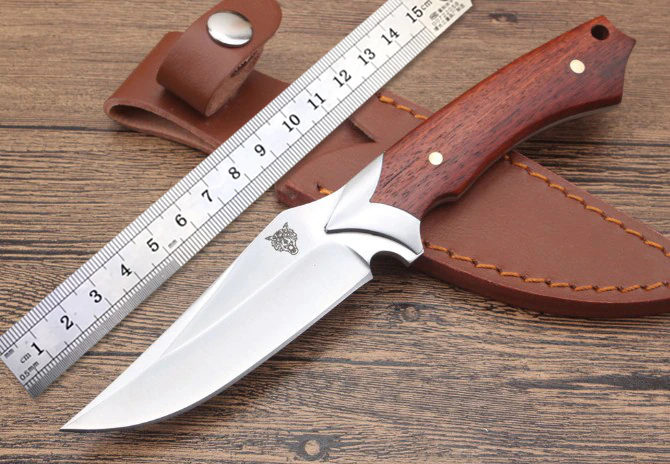
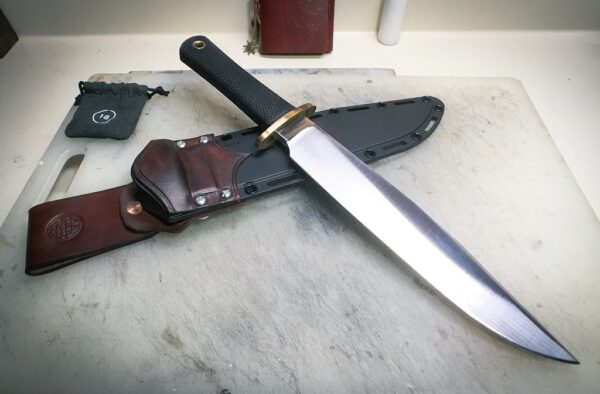
Outdoor Tactical Knife
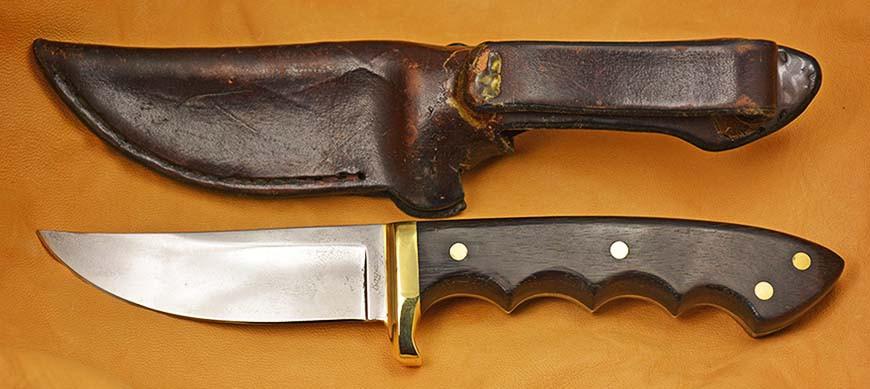
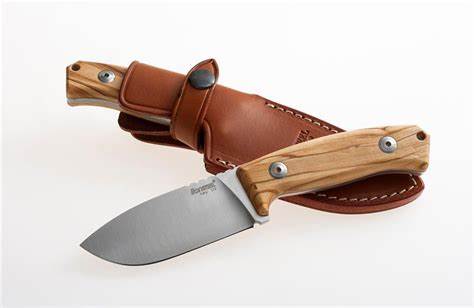
Hunting knife sharpener

425M Steel-VS-Block sharpener

The American Standard: Sharpening 154CM and 420HC with the Block Sharpener
When it comes to legendary American knife steels, two names stand out: 154CM and 420HC. Whether you are carrying a premium tactical folder or a classic Buck hunting knife, these steels are designed for performance. However, their vastly different carbon levels mean they require a sharpener that can adapt to both.
Here is why the Block Sharpener is the perfect tool for maintaining these American classics.
154CM: The “American Super Steel”
Often compared to the famous Japanese ATS-34, 154CM is a high-grade stainless steel produced by Crucible Industries. With a high carbon content of 1.05%, it is exceptionally hard and holds an edge far longer than standard stainless steels.
  • The Challenge: Because 154CM is so hard, it can be a nightmare to restore if the edge becomes truly dull. Traditional stones can take ages to “bite” into the metal.
  • The Block Solution: The Block Sharpener uses D2 Tool Steel rods (Rockwell 69+) that are significantly harder than the 154CM blade. By “keeping up with it” and using the sharpener for regular touch-ups, you can maintain that factory edge indefinitely without the struggle of a full regrind.
420HC: The Razor-Sharp Workhorse
Commonly utilized by companies like Buck Knives, 420HC features a lower carbon content (around 0.5%). It is a “tough” steel that is prized for its extreme corrosion resistance and its ability to take a incredibly fine edge.
  • The Challenge: While it sharpens easily, 420HC needs frequent honing to stay at peak performance, as the softer edge can roll during heavy use.
  • The Block Solution: This steel is where the Block Sharpener truly shines. Because of the steel’s fine grain structure, it achieves a shaving-sharp edge with ease when honed on the flexible rods. A few light passes realign the edge perfectly, making it a favorite for hunters who need to touch up their blade mid-task.
Why the “Flex” Matters for These Steels
Whether you are working with the hard, wear-resistant 154CM or the more flexible 420HC, the Block Sharpener’s patented flex design is key. It “squeezes” the blade to find the exact factory bevel. This ensures you aren’t grinding away the premium American steel, but rather honing it to a professional, razor-like finish.
The Verdict: If you value American-made steel, you need an American-made sharpener that can handle the range. From the “super steel” performance of 154CM to the user-friendly 420HC, the Block Sharpener delivers a shaving-sharp edge every time.

154 CM Steel

The AUS Series (Japanese Stainless Steel): These Sharpen great

ATS 34 Steel -Sharpening Benchmade knife Click Image

This steel is very similar to 154 CM. It has 1.05% carbon. It is also one of those classified in the super category. There are lots of high-end custom knives that use this steel. Sharpens great on the Block knife sharpener. (Shaving sharp) While many brands used ATS-34 extensively in the 1990s and early 2000s, Benchmade and Spyderco were the most prominent production companies to embrace this Hitachi-made Japanese stainless steel. 

ATS 55 Steel

 ATS-55, a stainless steel produced by Hitachi Metals. It is famously associated with Spyderco, which used it extensively in their knives during the late 1990s and early 2000s Harde to sharpen if to dull. sharpnes great when keep up with.
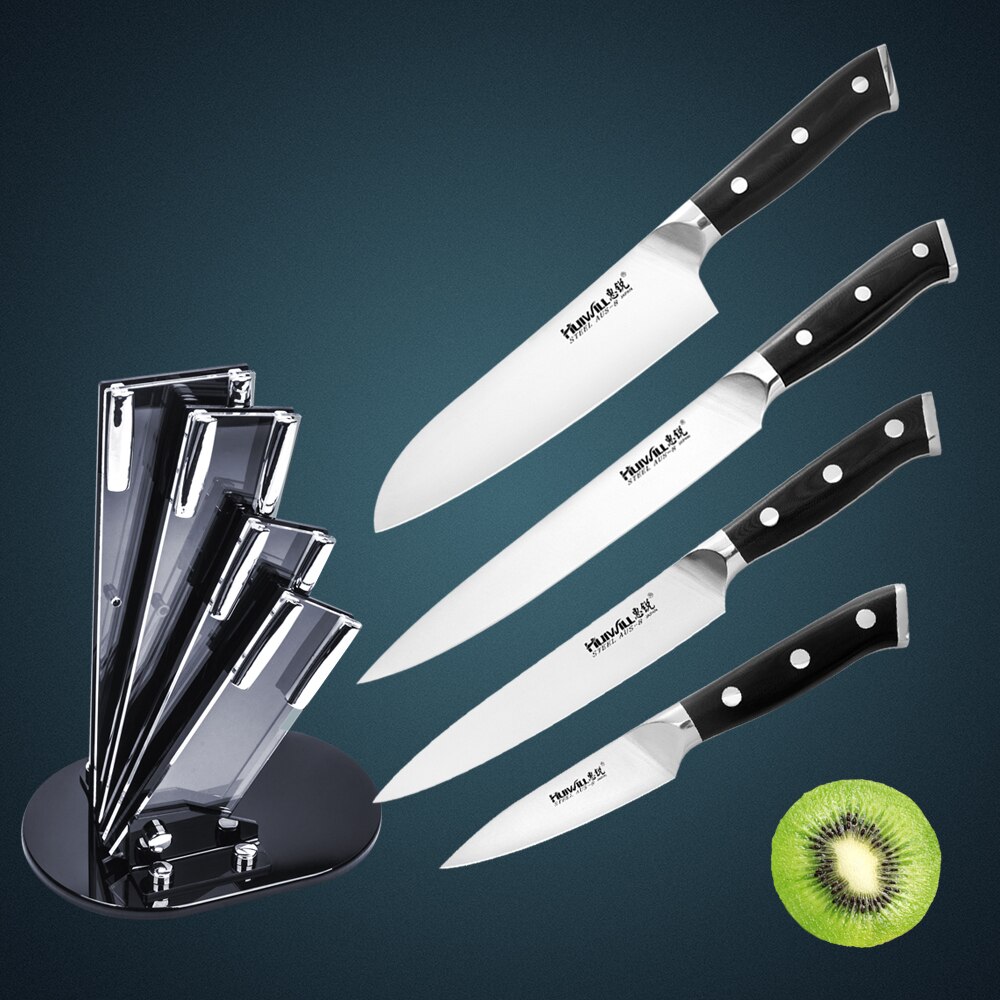
sharpener. (Shaving sharp) =Chef review Click Image

The biggest improvement of the AUS series over the 400 Series is the addition of vanadium which improves wear resistance and gives good toughness. It also makes the steel easier to sharpen. and its gets very sharp.

AUS-6 Steel

Has .65% carbon. sharpens good

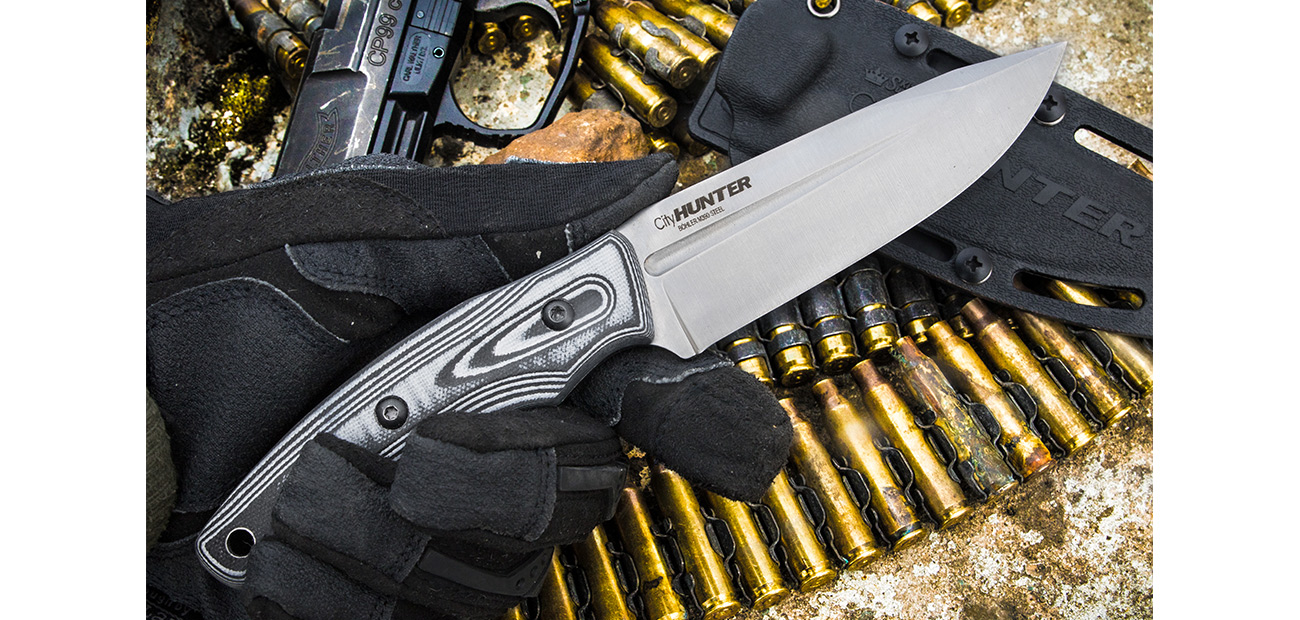
Bohler N680 Steel

Has .54% carbon. This is another very hard steel that is highly stain resistant, and so is good for saltwater applications. Sharpens great on a Block sharpener. But don’t let it get to dull, can be hard to sharpen.
STEELS USED IN MAKING KNIVES

N690 Steel

Sharpens great on a Block sharpener.  Has 1.07% carbon. This steel is made in Austria and is very similar to 440C. sharpens well.

Gingami 1 Steel (GIN 1)

This is a wonderful stainless steel. It has .80-.90% carbon. It has good edge retention. Sharpens great on a Block knife sharpener. G-1 stainless steel blade. Hiro is one of Seki, Japan’s most well-known manufacturers of the modern era, having produced knives for Browning, Puma, as well as many other companies over the years.

All of the early powder metallurgy stainless steels used a combination of high chromium (17+%) in combination with vanadium. These steels included the first (440V/S60V), high chromium reduces the amount of “pure” vanadium carbide that forms, instead making a vanadium-enriched chromium carbide which is higher in hardness than typical chromium carbide but not to the level of vanadium carbide. Therefore these three grades all have around 2% vanadium carbide [6][9][10] which is lower than steels with ~14% chromium like S30V which has 4% vanadium carbide, more than S60V despite having less vanadium.

SXXV Series (CPM): knives Sharpen great.

This series is becoming quite popular because of its strength, ability to resist rust, and how well it holds an edge. These can be difficult steels to sharpen though, if you do need to give them an edge the Block sharpener will do it. All of these knives are very wear resistant. This type of steel is also very difficult to mirror polish, so you will almost never see it. The 30, 60, and 90 in this series stand for 3%, 6%, and 9% vanadium in the alloy respectively.

Damascus Steel= Sharpening video Click Image

Modern Damascus steel is a beautiful work of art created through pattern welding—the process of layering, folding, and forge-welding different types of steel to create a single, high-performance blade. While this process yields a blade with legendary toughness and edge retention, not all Damascus is created equal.
Why High-Quality Damascus Sharpens So Well
Well-made Damascus knives from Japan or America use premium, known alloys (like VG10 or 1095/15N20) that have been professionally heat-treated.
  • The Secret is in the Temper: A quality Damascus blade has a consistent hardness that allows it to “take” a razor-sharp edge.
  • Safe for Precision Tools: High-end Damascus is hard and resilient. You can use the Block Sharpener with confidence because its patented flex rods squeeze the original bevel without the risk of chipping or tearing the delicate layers.
  • Honoring the Pattern: Proper sharpening only touches the very edge of the bevel, leaving the acid-etched beauty of the blade’s face untouched.
The Issue with “Cheap” Damascus
Knives often found for low prices at flea markets—frequently imported from Pakistan—are often made from scrap metal or “mystery” steels.
  • Inconsistent Hardness: These blades often skip the critical heat-treatment process. If the steel is too soft, it won’t form a “burr” and will simply roll over, making it nearly impossible to get truly sharp.
  • Mixed Quality Control: Because these are pumped out quickly, you might find “soft spots” in the metal or even impurities like lead. The Block Sharpener can still hone these blades better than most tools, but even the best sharpener cannot fix bad steel that isn’t hard enough to hold its shape.
Summary: Damascus Sharpening Performance
Feature Professional Damascus (Japan/USA) Budget “Pakistani” Damascus
Sharpness Razor-sharp, arm-shaving edge. Dull or inconsistent edge.
Edge Retention Exceptional; stays sharp longer. Poor; edge rolls easily.
Sharpening Result High performance with Block Sharpener. Difficult to apex; hard to maintain.
When you invest in a quality Damascus piece, maintaining it with a tool like the Block Sharpener ensures you protect your investment while keeping it functional and safe.
STEELS USED IN MAKING KNIVES

Ceramic blades coated over steel can be sharpened.

Solid Ceramic vs. Ceramic-Coated Blades
  • Solid Ceramic Blades: It is not recommended to use a Block sharpener on solid ceramic. Because ceramic lacks the flexibility of steel, the honing rods will likely chip the edge rather than realigning it. Sharpening these typically requires specialized diamond equipment.
  • Ceramic-Coated Steel Blades: If your blade is actually steel with a ceramic coating, the Block sharpener works exceptionally well. These blades often come out even sharper than they were when new because you are sharpening the steel edge hidden beneath the coating.
Pro Tip: To tell the difference, look closely at the very edge of the blade. If you see a exposed silver steel edge under the colored coating, it is safe to sharpen with your Block sharpener.

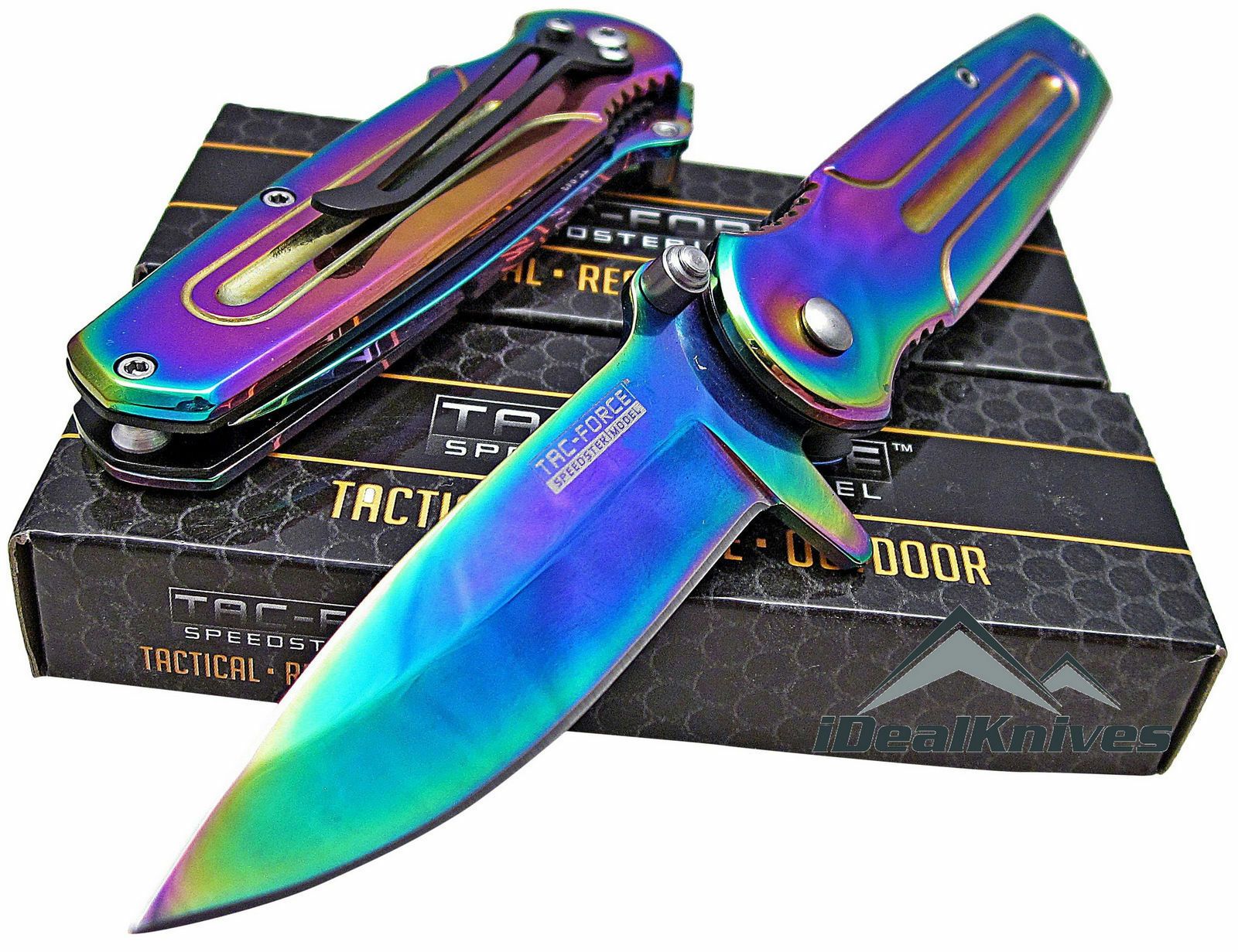
Titanium Blades- Block sharpens easy gets very sharp but they dull easy too.

Titanium is favored for its lightweight and high durability. Although it doesn’t retain sharpness well, making it less ideal for blades, it is still used in diving knives and certain custom knives. When sharpened on a block sharpener, it can become very sharp.
STEELS USED IN MAKING KNIVES

BG 42 Steel

Sharpens Ok, some good some suck. This is a relatively new stainless steel that has excellent rust resistance. It is gaining popularity as custom knife makers begin using this steel. Sharpens well and holds the edge.

Bohler M390 Steel

Has 1.9% carbon. This material is very stain resistant and has excellent wear resistance. It has vanadium as an additive, consequently, is a popular hard steel. This is also the type of steel used most often for surgical applications. Sharpens very sharp on a Block sharpener.

CPM 3v steel

Sharpens great with a Block sharpener. CPM 3V Steel? Toughness. CPM 3V steel has its advantages when it is used in a knife. It makes a great field knife blade that is tough and unlikely to break with heavy, near abusive, use. It will likely oxidize over time depending on the working environment, 3V steel is not stainless. Different types of steel have different properties, and some are better for knives than others. There are four general properties which most use to evaluate knife steel:

Edge Retention/Wear Resistance (how the cutting edge holds up to cutting use)
Toughness (how durable the blade is)
Heat treatment (The hardness of the steel)
Corrosion resistance (Amount of chromium in the composition of the steel, chromium content over 11% is considered stainless)

What does CPM stand for? Crucible Particle Metallurgy (CPM)

Cpm-S60v

All of the early powder metallurgy stainless steels used a combination of high chromium (17+%) in combination with vanadium. These steels included the first (440V/S60V), and  and Uddeholm’s Elmax. The high chromium reduces the amount of “pure” vanadium carbide that forms, instead making a vanadium-enriched chromium carbide which is higher in hardness than typical chromium carbide but not to the level of vanadium carbide. Therefore these three grades all have around 2% vanadium carbide [6][9][10] which is lower than steels with ~14% chromium like S30V which has 4% vanadium carbide, more than S60V despite having less vanadium.

All of the early powder metallurgy stainless steels used a combination of high chromium (17+%) in combination with vanadium. These steels included the first (440V/S60V), and Bohler’s M390 The high chromium reduces the amount of “pure” vanadium carbide that forms, instead making a vanadium-enriched chromium carbide which is higher in hardness than typical chromium carbide but not to the level of vanadium carbide. Therefore these three grades all have around 2% vanadium carbide [6][9][10] which is lower than steels with ~14% chromium like S30V which has 4% vanadium carbide, more than S60V despite having less vanadium.

Unlock the Art of Knife Sharpening

At Stay Sharp, we believe a sharp knife makes all the difference in the kitchen. Our unique approach to knife sharpening combines science with craftsmanship to give you an unparalleled edge. When you use our sharpeners, you’re not just enhancing sharpness; you’re realigning the steel’s molecules for a perfect finish. Our patented technology works seamlessly with each blade’s features, delivering results that maintain the knife’s overall strength and performance.

Translate »