FAQ-Block sharpener

Knife sharpener
The Block Knife Sharpener is a manual, handheld tool designed to hone and realign blades rather than aggressively grinding them down. It is often sold at trade shows and gun shows by the Block family. Mechanism: It uses two crisscrossing honing rods (originally made of 1018 steel, now upgraded to harder D2 tool steel). Patented Flex Design: The handle is designed to flex, allowing the rods to automatically adjust to the knife’s original bevel angle (typically between 17 and 28 degrees). Honing vs. Grinding: Unlike pull-through sharpeners that peel off metal, this tool hones the edge by realigning the existing steel. Versatility: Because of the flexible rods, it can sharpen varied edges, including serrated knives, scissors, and even curved blades like machetes. For serrated blades, it creates a "chattering" action that lets the rods reach deep into the teeth.
Q: Why choose Block Sharpener as your go-to American knife sharpener?

A: Our American knife sharpener is proudly made in the USA, delivering unmatched durability, precision, and ease for home cooks and professionals alike.

Choosing a Block Sharpener is often preferred by knife enthusiasts because its patented flex design solves the biggest problem with manual sharpeners: maintaining the correct angle
1. It Protects Your Original Factory Edge [1]
Unlike standard “V-slot” sharpeners that force a fixed angle onto your blade, the rods in a Block Sharpener flex and squeeze. This allows the sharpener to automatically adjust to your knife’s existing factory bevel—whether it’s 17° or 28°—meaning you won’t accidentally grind a new, uneven angle into an expensive blade.
2. High-Performance D2 Tool Steel
While most portable sharpeners use ceramic or soft steel, Block Sharpeners use heat-treated D2 Tool Steel with a Rockwell hardness over 69. This makes them hard enough to effectively realign the “super-steels” (like S30V or Magna Cut) found in premium knives that often resist standard sharpening tools. 
3. Realignment vs. Grinding
Most “quick” sharpeners are aggressive and peel off metal curls, which shortens the life of your knife. The Block system functions more like a professional chef’s honing steel, realigning the edge and removing burrs without tearing the steel. This preserves the blade material while still delivering a razor-sharp finish.  Unmatched Versatility
Because the rods flex, this single tool is capable of sharpening a massive variety of edges that would usually require separate systems: 
    • Serrated Edges: Reaches deep into the teeth without flattening them.
    • Large Tools: Easily handles machetes, axes, and even swords.
    • Household Items: Works on scissors, garden loppers, and electric carving knives. 

5. Built for the Field
It is designed for portability with non-slip rubber grips and a dedicated thumb guide, allowing you to sharpen safely even when you don’t have a flat surface or workbench available. It is American-made and comes with a lifetime guarantee
Safety feathers on new model Block sharpener.

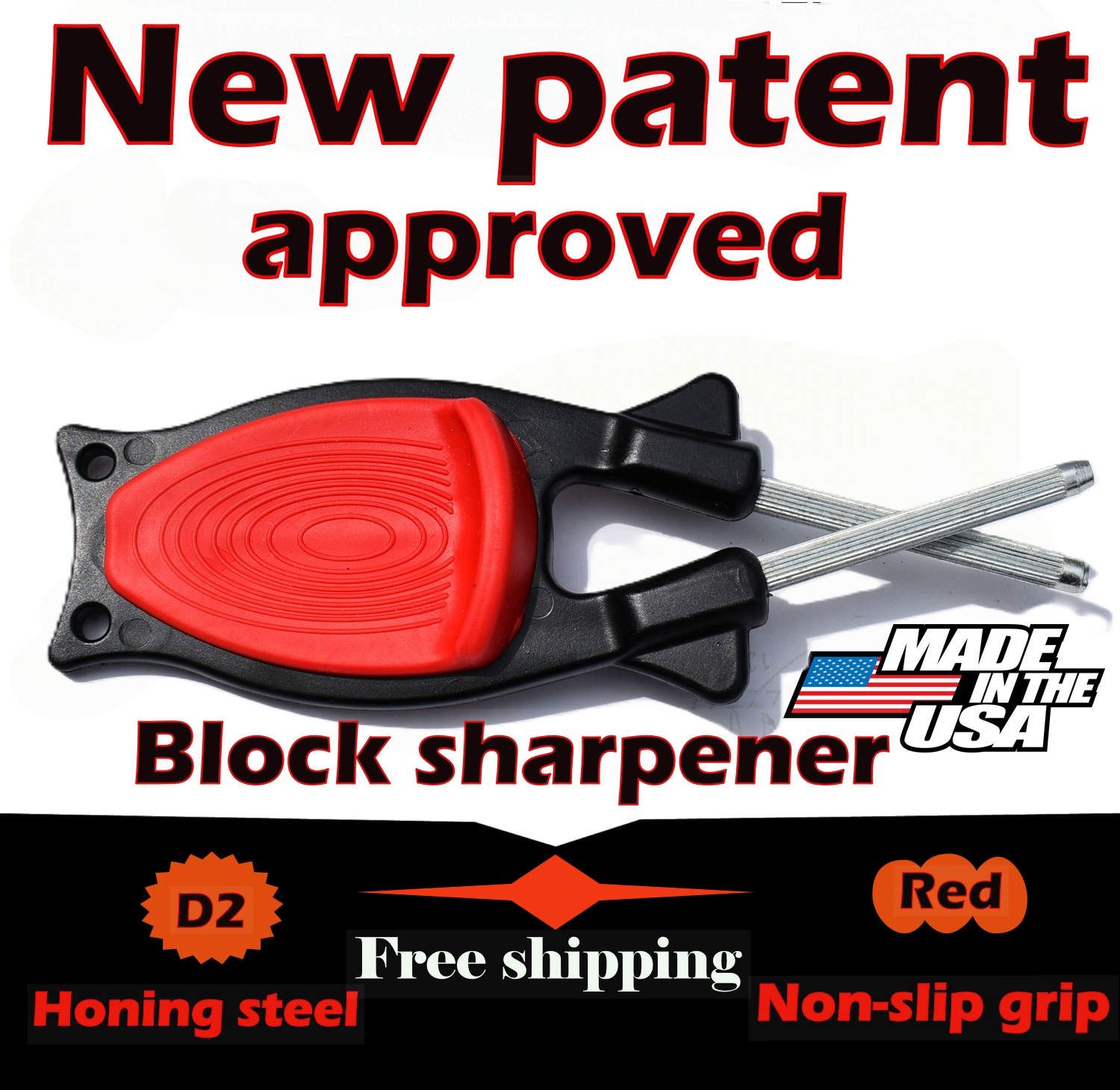
The new Block knife sharpener model features a nonslip grip on both the top and bottom of the handle, giving you excellent control and a secure hold while handling.

The Block Sharpener is designed with several integrated safety features to provide maximum control, whether you’re using it on a kitchen counter or freehand in the field.
Key Safety Features
    • Dual-Sided Non-Slip Grips: The latest models feature a high-traction rubber overlay on both the top and bottom of the handle. This ensures the sharpener stays firmly in place on slippery countertops or cutting boards.
    • Patented Thumb Grip: An ergonomic, rubber-coated thumb rest on the top side allows for a secure, “locked-in” hold. This is critical for freehand sharpening of oddly shaped tools like scissors, machetes, or gardening clippers when no flat surface is available.
    • Integrated Safety Guard: The handle includes a built-in guard that acts as a physical barrier between your hand and the blade as you draw it through the honing rods.
    • Mounting Holes: For heavy-duty professional use or when sharpening large blades like machetes, you can use the built-in mounting holes to screw the sharpener down permanently to a workbench for absolute stability.
    • Edge-Leading Control: Because the rods flex and “squeeze” the blade, the tool prevents the knife from slipping out of the sharpening slot, which is a common hazard with traditional fixed-stone sharpeners. 

Safety Tip: When sharpening handheld, always keep your fingers behind the built-in guard and use Havy to moderate pressure to let the D2 rods do the work.
 
Q: What makes this the best professional knife sharpener?

A: Crafted with a patented design, the Block stands out as the best professional knife sharpener, trusted by chefs for consistent razor-sharp edges on every blade.

What sets the Block Sharpener apart as a “professional” choice is its ability to act as a portable honing station rather than a simple grinder.
Here are the four main reasons it’s considered the top tier for professionals:
    • Heat-Treated D2 Tool Steel: Most sharpeners use ceramic or cheap stainless steel. The Block Sharpener uses D2 Tool Steel hardened to a high Rockwell scale. This is tough enough to realign the “super steels” found in professional chef and tactical knives (like S30V or D2) that cheaper sharpeners can’t even touch.
    • The Patented Flex Design: Professional sharpening usually requires holding a perfect 15° or 20° angle by hand. The Block Sharpener removes the guesswork; its rods flex and “squeeze” to match the existing factory bevel of your knife. This means you’re maintaining the knife’s original integrity rather than forcing a new, potentially uneven angle.
    • Multi-Blade Versatility: A pro needs one tool that does it all. Because of that flex, it handles serrated edges, scissors, loppers, and even hatchets just as easily as a standard kitchen knife. It’s the only tool that can reach into the “gullets” of serrations without flattening the teeth.
    • Edge Preservation (Honing vs. Grinding): Traditional pull-through sharpeners have V-shaped carbide cutters that shave off metal curls, eventually “eating” your knife. The Block Sharpener hones—it realigns the microscopic edge. This keeps your knives razor-sharp for years without thinning the blade.

Pro Tip: If you have a very dull blade, you can use heavy pressure to “break” the edge back into shape, then switch to light “feather” strokes to polish it to a professional finish.
Q: Why is this the best pocketknife sharpener for everyday carry?

A: Compact and rugged, the Block is the best pocketknife sharpener, ensuring sharp edges on the go for camping, fishing, and outdoor adventures. 

Pocketknife sharpener

New patent approved Pocketknife sharpener.

Block sharpeners are often considered the best portable option because they combine professional-grade D2 tool steel with a patented flex design that adapts to any blade angle, all in a compact, lightweight package. [1, 2, 3]
Why They Excel in the Field
  • Adapts to Any Angle: The flexible rods naturally “squeeze” to follow your knife’s original factory bevel (from 17° to 28°), eliminating the need for bulky angle guides.
  • Versatile “All-in-One” Tool: A single Block Sharpener can handle everything from a delicate fillet knife to heavy-duty machetes, axes, and even serrated pocket knives.
  • Rugged and Secure: Designed for “on-the-go” use, they feature non-slip rubber grips on both the top and bottom, plus a dedicated thumb grip. This makes them safe to use handheld even when you don’t have a stable table or workbench in the woods.
  • Hones without Grinding: Instead of tearing away metal like cheap pull-throughs, the high Rockwell rods realign the edge. This is critical for maintaining expensive hunting or EDC knives while away from a full shop.
  • American-Made Durability: Built to last with a lifetime guarantee, these are durable enough to be tossed into a hunting pack or tackle box without worry
What makes best kitchen knife sharpener work?
The Block Sharpener is designed with several integrated safety features to provide maximum control, whether you’re using it on a kitchen counter or freehand in the field.
Knife Maintenance

When it comes to knife maintenance, the Block sharpener is the choice of many chefs and outdoorsmen alike.

Key Safety Features
    • Dual-Sided Non-Slip Grips: The latest models feature a high-traction rubber overlay on both the top and bottom of the handle. This ensures the sharpener stays firmly in place on slippery countertops or cutting boards.
    • Patented Thumb Grip: An ergonomic, rubber-coated thumb rest on the top side allows for a secure, “locked-in” hold. This is critical for freehand sharpening of oddly shaped tools like scissors, machetes, or gardening clippers when no flat surface is available.
    • Integrated Safety Guard: The handle includes a built-in guard that acts as a physical barrier between your hand and the blade as you draw it through the honing rods.
    • Mounting Holes: For heavy-duty professional use or when sharpening large blades like machetes, you can use the built-in mounting holes to screw the sharpener down permanently to a workbench for absolute stability.
    • Edge-Leading Control: Because the rods flex and “squeeze” the blade, the tool prevents the knife from slipping out of the sharpening slot, which is a common hazard with traditional fixed-stone sharpeners. 

Safety Tip: When sharpening handheld, always keep your fingers behind the built-in guard and use light to moderate pressure to let the D2 rods do the work.
 
Q: Why is it perfect as a knife sharpener for hunting knives?

A: Built for precision, our knife sharpener for hunting knives ensures razor edges in the field, giving hunters reliable blade performance every time.

Knife sharpener for Hunting knives.

What makes the Block Sharpener stand out is its ability to act as a flexible honing steel rather than a standard “grinder.” It’s designed to bring an edge back to life without the risk of ruining your knife’s geometry.
Here are the key reasons it’s considered a top-tier tool:
1. The Patented Flex Design
Most sharpeners have a fixed “V” shape that forces a single angle on every knife. The Block Sharpener’s rods flex and squeeze to match your knife’s existing factory bevel. This means it adapts to your blade—whether it’s a 15° chef’s knife or a 25° hunting knife—ensuring you don’t grind away unnecessary metal.
2. High-Hardness D2 Tool Steel
The rods are made from heat-treated D2 Tool Steel (hardened to 69+ Rockwell). This is much harder than the steel in most knives, including premium brands like Benchmade. Because it’s so hard, it can effectively realign “super steels” that ceramic or cheaper steel sharpeners simply can’t touch.
3. Realignment (Honing) vs. Grinding
Cheaper pull-through sharpeners use carbide cutters that shave off curls of metal, which eventually “eats” your blade. The Block Sharpener hones the edge, realigning the microscopic teeth of the steel. This keeps your knives razor-sharp while significantly extending their lifespan.
4. Extreme Versatility
Because the rods can open and close, this one tool handles a massive variety of edges:
Serrations: It reaches into the scallops of bread or pocket knives without flattening the teeth.
Large Tools: It’s strong enough for machetes, axes, and even lawnmower blades.
Precision Items: It works perfectly for scissors, loppers, and even electric carving knives.

5. Built for the Field
It’s lightweight, portable, and features a non-slip rubber grip with a dedicated thumb guard. This makes it safe to use “freehand” in the woods or at a campsite, and it’s made in the USA with a lifetime guarantee.

Q; What is the difference from original Block sharpeners and new models?
Knife sharpener

FAQ about the block sharpener

Knife sharpener

est 2014 Maintain precision and efficiency with the most exceptional knife sharpener, a tool that redefines utility and innovation since the dawn of civilization.

The new models have a nonslip over-shoot on the top and bottom of the sharpener handle, with a thumb grip and guard. The new models also use a high Rockwell D-2 tool steel for honing rods. Original Block sharpeners honing rods were made with 1060 steel and have no safety features. 

Original military green Block sharpener with gold color 1018 honing steel

Original Block sharpener made in Usa-1969 -2016

Do edge maker sharpeners work the same?
Knife sharpeners

They do not work the same.

No they do not work the same the edge maker sharpeners rods are fix angles, They do not adjust to your edge. There for they can change original cutting edges. Keeping original edges is much better for your blades, they will stay sharper longer and will not DeVaul well-made knives.

The Edge Maker and Block Sharpener look similar, but they do not work the same way. While both use crossed rods to hone a blade, their core mechanics and results are quite different. [1, 2]
Key Differences
    • Flexibility vs. Fixed Angle: The Block Sharpener features a patented flex design that allows the rods to adjust to your knife’s existing factory angle (typically between 17° and 28°). In contrast, the Edge Maker uses fixed angles, which may force a new bevel onto your blade if it doesn’t match perfectly.
    • Honing vs. Sharpening: The Block Sharpener acts more like a flexible “chef’s steel,” focusing on realigning the edge without removing significant metal, which preserves the life of expensive knives like Benchmades. The Edge Maker is often described as more aggressive; while it can put an edge on quickly, some users find that the edge requires more frequent touch-ups because it doesn’t hone as effectively as a traditional system.
    • Versatility:
        • Block Sharpener: Known for its ability to handle serrations, scissors, and large blades (like machetes or swords) because the rods can “squeeze” and conform to different shapes.
        • Edge Maker: Typically uses a multi-step system with different color-coded tools (orange for sharpening, yellow for honing) to achieve a finished edge. [1, 2, 3, 4, 5, 6, 7, 8, 9]

Summary Comparison
Block SharpenerEdge Maker
Angle System

Patented Flex (Adjusts to your knife) [1, 2]

Angle System

Fixed Angle (Set by the tool)

Steel Type

High Rockwell D2 Tool Steel [1]

Steel Type

Case Hardened/Plated Steel [1]

Metal Removal

Minimal to none (mostly honing) [1, 2]

Metal Removal

Moderate (removes metal to sharpen) [1, 2]

Best For

Premium knives, serrations, scissors [1, 2, 3]

Best For

Quick utility sharpening for work knives [1]

If you are maintaining a high-end Benchmade with premium steel, the Block Sharpener is generally safer because it adapts to the knife’s original geometry rather than grinding it down
Q: Can it sharpen serrated knives like bread knives?

A: Absolutely,

Yes, a Block Sharpener is specifically designed to sharpen serrated edges without damaging the teeth. Its patented flexible rods allow it to reach into the scallops and follow the original factory bevel of almost any serrated blade, including bread knives, steak knives, and serrated pocket knives like those from Benchmade or Spyderco. [1, 2, 3, 4]
Serrated Knife Sharpener Online

How to sharpen Spyder Co Serrated Edges with a Block Knife ...

Why it works for serrations:
    • Flexible Honing Rods: The rods in a Block Sharpener are designed to “squeeze back” and conform to the shape of the teeth as you pull the knife through.
    • Complete Coverage: Unlike flat stones or standard pull-through sharpeners that only hit the tips of the serrations, the rounded rods can contact the knife from the tips to the base of each tooth.
    • Preserves the Edge: It focuses on realigning (honing) the existing edge rather than grinding away significant amounts of metal, which helps maintain the life of your serrated teeth. [1, 2, 3, 4]

How to use it on a serrated knife:
  1. Position the Blade: Place the serrated edge in the middle of the rods.
  2. Use a “Rocking” Motion: As you draw the knife through, rock it slightly up and down (like a boat). This helps the flexible pins open and close to fit between each individual tooth.
  3. Light Pressure: Use light, consistent pressure. For serrations, the goal is often to simply realign the edge and remove any tiny burrs.
  4.  
Block sharpener for kitchen knife sharpener

A: Yes, our kitchen knife sharpener restores dull blades effortlessly, making food preparation smoother, quicker, and safer for every home kitchen. 

Handheld kitchen knife sharpener restoring a professional chef's knife.

Quick and simple to use Knife sharpener that hones blades.


Yes, the Block Sharpener is an excellent choice for kitchen knives, especially if you want a professional-grade edge without the steep learning curve of a whetstone. It is specifically designed to act as a portable honing station that maintains the life of your cutlery. [1]
Why it’s great for the kitchen:
  • Edge Preservation: Unlike cheap abrasive pull-through sharpeners that grind away curls of metal, the Block Sharpener uses D2 tool steel rods to realign (hone) the edge. This makes it safe for daily maintenance on high-end kitchen sets without “eating” the blade.
  • Automatic Angle Adjustment: Kitchen knives come in various factory angles (e.g., 15° for Japanese blades or 20° for German steel). The patented flex design automatically adapts to these angles, ensuring you hit the original bevel perfectly every time.
  • Handles Serrated Knives: Most kitchen sharpeners ruin bread knives by flattening the teeth. The Block Sharpener’s flexible rods can reach into the “scallops” of serrated edges to hone each individual tooth.
  • Versatile Beyond Knives: It effectively sharpens other kitchen essentials that standard systems can’t, including kitchen shears, scissors, and electric carving knives
Q: Does Block also work as a sharpener for scissors?

A: Yes, the Block functions as a reliable sharpener for scissors, restoring precision edges fast, so your cutting tools always perform at their best.

Q: Can the Block sharpen large blades like swords?

Our sharpener can handle very long blades and was even used for the final finish on the world’s largest Bowie knife at the Knife Shoppe store in Tennessee. 11 feet long. Block sharpeners are perfect for sharpening machetes, and the sword sharpener easily manages longer blades, restoring balance and edge sharpness while preserving the integrity of your valuable blades.

world largest Bowie knife

Paul Block put the finishing touch on the world’s largest Bowie knife.

Q: Is Block good for sharpening machetes?
Matchet sharpener

Block Sharpener makes a great tool for keeping your machete sharp and ready.

Yes, the Block Sharpener is specifically designed to handle large blades like machetes, swords, and even katanas. Because it uses flexible rods, it can follow the long, sweeping curves of a machete’s edge without you having to worry about maintaining a perfectly consistent angle by hand. [1, 2, 3]
How to Sharpen a Machete with a Block Sharpener
Since a machete is much longer and heavier than a standard pocket knife, the technique is slightly different: [1]
    • Stabilize the Sharpener: For very long blades, it is highly recommended to screw the sharpener down to a workbench or counter using the mounting holes (dimples) in the base. This keeps it from sliding while you pull the heavy blade through.
    • Positioning: Stand behind the blade and draw it through the rods from the heel (near the handle) to the tip.
    • The Flex Advantage: Machetes often have slightly different factory angles along the blade. The Block Sharpener’s rods flex and adjust to these variations, ensuring you hit the original bevel accurately along the entire length.
    • Field vs. Shop: While it can be used handheld in the field with caution, securing it to a stable surface is the safest way to get a razor-sharp edge on such a large tool. [1, 2, 3, 4]

Note on Blade Hardness: Machetes are typically made from slightly softer steel than high-end pocket knives to prevent chipping during heavy chopping. The D2 tool steel rods in your Block Sharpener are much harder than standard machete steel, meaning they will realign and sharpen the edge very quickly
Q: Can I use Block on outdoor tools?
Garden tool sharpener

Block sharpeners are excellent for keeping garden tools sharp.

A: Yes, our garden tool sharpener restores edges on shears, pruners, and axes, making yard work faster and blades more effective season after season. 

Q: Is the original Block knife sharpener design available?

A: Yes, we offer the original Block knife sharpener with the same patented flex performance. The Original Block sharpeners use 160 heat-treated steel and have a non-slip grip. It’s best to fasten them down to a workbench.

Q: do the Block knife sharpeners colors make a differnce?
Block knife sharpeners

Dose Block sharpeners colors make a difference?

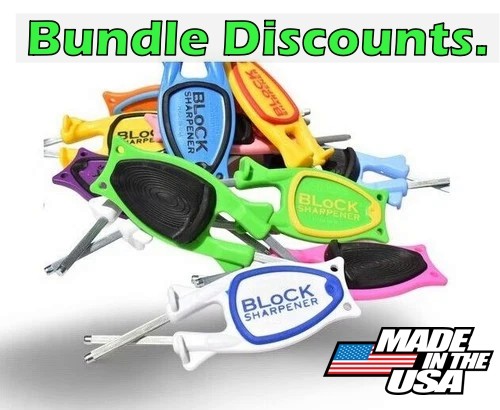
A: no colors your choice, we offer Block knife sharpeners in many different colors with the same patented performance. 

What are other uses for Block's sharpeners

Yes, according to the manufacturer, 

Block’s Sharpeners

 are highly versatile and suitable for sharpening a variety of tools beyond just kitchen and outdoor knives, including scissors and various garden tools. 

 
Uses for Block’s Sharpeners
The unique “flex design” allows the sharpening rods to adjust to a wide array of cutting edges, making it a multi-purpose tool. 
Specific tools the manufacturer states can be sharpened: 
  • Scissors: Designed to restore the sharpness of household, kitchen, or general utility scissors.
  • Gardening Clippers/Shears: Suitable for various hand-held garden tools like clippers, pruners, and sheers.
  • Hatchets and Machetes: The robust design can handle the larger, thicker blades of these tools.
  • Cleavers and Swords: It can be used for large kitchen cleavers as well as specialized blades like swords and daggers.
  • Specialty Blades: The manufacturer mentions effectiveness on items like farm sickles, seaweed cutters, ULU knives, and hawkbill knives.
  • Serrated Edges: It can also be used to sharpen many types of serrated blades. 
Q; Can a Block sharpener sharpen serrated edges?

– Block Sharpener sharpens any serrated edge with a 100% guarantee, without wearing down or damaging the teeth, making blades sharper than new.  

– Classic serrated edge: Features sharp, jagged tips for tearing through food; density varies for different bite levels; ideal for hard crusts.  

– Scalloped edge: Inverted serration for smoother cutting; best for softer foods like cakes, sandwiches, or carving; offers a gentle saw-like action.  

– Double serrated edge: Combines sharp tips with scallops for balanced tearing and cutting; raised tips protect scallops from wear, extending edge lifespan.  

– Blocl sharpener Delivers superior performance for most kitchen tasks; sharpened to exceed original sharpness; safe for all serrated blades.  The Block Sharpener can sharpen any serrated edge with a 100% guarantee. It won’t wear down or damage the teeth, and it will make any serrated blade sharper than when it was new.

There are different types of serrated edges you can sharpen with a Block sharpener:

Block sharpeners Sharpens Classic serrated edge

The classic serrated edge is the most common type of serration, featuring sharp, jagged tips designed to tear through food. The density of the serration can vary, with less dense serrations (fewer tips with more space in between) offering more bite, as the cutting pressure is concentrated on fewer points. This type of serration is ideal for cutting through anything with a hard crust.

Classic serrated edge teeth with sharp tips

Scalloped edge sharpens great with a Block sharpener. 

In a scalloped edge, the serration is inverted compared to the classic serrated edge. This design makes it less aggressive, making it the ideal choice for cutting softer foods like cakes, sandwiches, or even for carving. Instead of tearing through food, the scalloped edge provides a smooth cutting action with a subtle saw-like effect.

serrated knife edge with wide scallops inverted teeth
Serrated knife edge with narrow scallops inverted teeth

Double serrated edge sharpens great with a Block sharpener

This edge features two different serration profiles: raised, sharp tips with scallops in between. This design offers two key benefits: The sharp tips provide enough aggression to tear through tougher skins or crusts, while the scalloped sections offer a smoother, less aggressive cutting action, resulting in a balance between tearing and cutting. The raised tips will protect the scallops from direct contact with the cutting board, significantly reducing wear and extending the lifespan of the edge.

Serrated edge with double serration raised teeth

Straight Edge also will get much sharper than brand new, with the Block sharpener,

In most kitchen tasks, a straight edge delivers superior results, which is why the vast majority of knives sold feature this design. Block sharpeners have tested on every serrated edge blade ever made, it will not damage any edges, will take all serrated edges much sharper than brand new

Dose the Block sharpener leave lips or burrs?

Block sharpeners stand out from other handheld sharpeners thanks to their patented flex design. They hone your edges without leaving lips, burrs, nicks, or rolled edges, and can even handle any serrated edge, sharpens all without wearing your cutting edges down. 

Quick Tip for Benchmade Blades:
The Block Sharpener is actually a great match for Benchmade knives because of the specific way it handles high-hardness steels like S30V, S90V, and MagnaCut.
Here is how it performs on a Benchmade:
    • D2 Steel Advantage: Benchmade knives use very “tough” steels that can be difficult to sharpen with ceramic or soft steel rods. Since your Block Sharpener uses heat-treated D2 tool steel, it is hard enough to effectively realign the edge on these premium blades without slipping or wearing down.
    • Edge Alignment (Honing): Most Benchmade users find that their knives don’t actually need metal removed (grinding); they just need the edge realigned. The Block Sharpener excels at this honing process, bringing back a razor edge in seconds without the risk of scratching that expensive Benchmade finish.
    • Flex Design for Consistency: Benchmade edges are typically set at a factory angle of 15–17 degrees per side. The patented flex design of your Block Sharpener allows the rods to adjust to that specific factory angle naturally, so you aren’t fighting the knife’s geometry or accidentally creating a new, uneven bevel.
    • Safety for the Finish: Unlike pull-through sharpeners with V-shaped carbide cutters that can shave off curls of metal and scratch the blade face, the Block Sharpener only touches the very edge of the bevel. This is crucial if you have a Cerakote or DLC coated Benchmade (like an Infidel or Bugout) and want to keep the coating looking brand new.

 Use Havey to medium pressure, make rods adjust to blade. Let the D2 rods do the work of “guiding” the edge back into place. For very hard steels like S90V, you might need a few extra passes (10–15) compared to a standard kitchen knife.
Block sharpener
greatest knife sharpener since the stone age The phrase "greatest knife sharpener since the stone age" is the signature slogan of the Block Sharpener, an American-made handheld tool designed for versatile blade maintenance. Block sharpener Block sharpener +1 Key Features of the Block Sharpener Patented Flex Design: The sharpener uses two honing rods that automatically adjust to a blade's original factory edge, handling angles from 17° to 28°. High-Quality Materials: It features High Rockwell Butcher Steels (D2 tool steel), which are hard enough to sharpen tough materials like Damascus, S30V, and high-carbon steel without tearing the metal. Versatile Sharpening: It is advertised to handle almost any blade, including: Kitchen & Pocket Knives: Maintains standard V-edges and hollow grinds. Serrated Blades: Effectively hones serrated edges on steak and pocket knives. Outdoor Tools: Can be used on hatchets, machetes, and even scissors. Safety & Portability: Designed for "free-hand" use in the woods or at home, it includes a non-slip rubberized grip and a thumb guard for control on slippery surfaces. Block sharpener Block sharpener +5 Why it’s Distinct from Standard Sharpeners Unlike many pull-through sharpeners that "peel" or remove excessive metal to create a new edge, the Block Sharpener is primarily a honing tool. It works by realigning and "relining" the existing edge to restore sharpness without causing nicks or burrs
Translate »