×
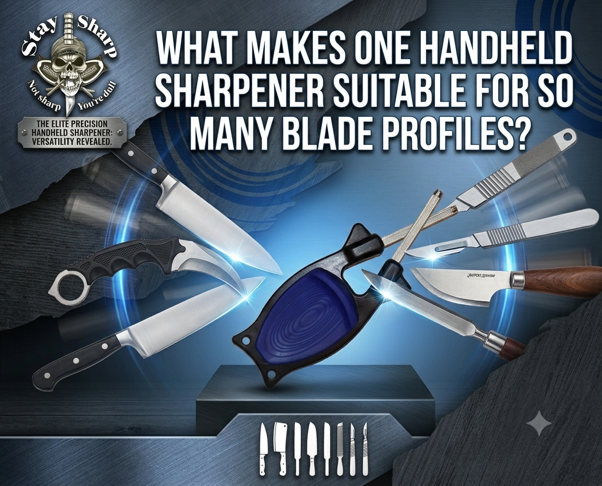
Ever tried sharpening two different knives and noticed they do not move through the sharpener in quite the same way? That difference comes from the shape of the blade edge. Chef’s knives, pocketknives, hunting knives, and serrated blades can all have different profiles. So, the best handheld knife sharpener should be able to follow those differences instead of forcing every blade into the same fixed path.
A blade profile describes the shape and angle of its cutting edge. Some knives use a standard V edge, while others have convex, chisel, hollow-ground, double-bevel, or compound edges. Serrated blades have another distinct shape.
A rigid slot keeps a blade at one set angle. A flexible system can respond to the edge as it moves through the rods. That makes the blade profile an important part of choosing a handheld sharpener.
The patented flex handle is at the center of the Block design. Two honing rods cross inside the handle. When the blade enters between them, the rods flex open and adjust around the existing bevel.
The current design accommodates blade angles of approximately 17° to 28°. The user does not need to set a separate angle before each pass.
This design also keeps the honing rods connected to the blade as its shape changes along the cutting edge.
Newer models use heat-treated D2 tool steel rods, with hardness described as up to approximately 69 Rockwell. The rods are built for hard knife steels, including high-carbon, stainless, and Damascus blades.
The two rods work together to hone and realign the existing edge. This approach focuses on maintaining the blade’s established geometry during regular edge care.
The flexible rod system works across a wide mix of blade shapes and cutting tools, including:
This broad range makes the tool useful for people who keep several types of blades in their kitchen, workshop, garden, or outdoor gear.
Serrated blades use a different motion. Place the blade in the center of the honing rods and use a light rocking or side-to-side movement. This creates a chattering action through the serrations.
The same flexible contact works with curved and unusual blade shapes. Examples include snake-shaped blades, ULU knives, hawkbills, farm sickles, and seaweed cutters.
Correct movement keeps the rods in contact with the cutting edge. Start by placing the heel between the rods. Pull the blade toward you in one smooth motion. As the curved part of the blade approaches the rods, lift the rear of the sharpener.
Continue the movement through the tip. This follows the blade’s changing shape instead of treating the entire edge as one straight line.
Pressure can change during the sharpening process. A very dull edge can begin with firmer pressure so the rods engage the blade. As the edge improves, lighter passes are used for finishing.
Severely dull blades can take around 20 to 30 pulls before the edge is established. A leather strop can also follow the honing process to further align microscopic burrs and refine the finish.
The Block system focuses on honing, realigning, and maintaining an existing blade edge. A blade with large chips, missing sections, or a completely rounded edge needs its basic shape restored first with a stone or file.
Ceramic blades require diamond equipment because steel honing rods do not provide the abrasive action needed for ceramic material.
When comparing knife sharpeners for sale, look at how the sharpening system meets the blade. A flexible mechanism can be useful when one household has several edge styles.
| Feature | Details |
|---|---|
| Block Design | Patented flex handle |
| Rod Design | Two crisscrossing rods |
| Current Angle Range | Approximately 17° to 28° |
| Rod Material | D2 tool steel on newer models |
| Operation | Manual and handheld |
| Edge Support | Straight, curved, serrated, and specialty profiles |
The design also includes non-slip upper and lower grips and an integrated thumb grip for added control.
A handheld sharpener can travel with the tools it maintains. The compact freehand design fits naturally into different settings, from a home kitchen to an outdoor trip.
It can be used for:
The thumb grip also supports freehand use when a stable tabletop is unavailable.
The best handheld knife sharpener for a varied blade collection needs to respond to different edge shapes. A flexing handle and dual honing rods give the user a way to follow the existing bevel while drawing the blade through the tool.
That design suits people who use several kinds of knives and cutting tools rather than keeping one sharpener for each blade style.
For shoppers looking through knife sharpeners for sale, Block Sharpener offers several models and color options, including kitchen, outdoor, sport, tactical, premium, and original versions. Explore the range to find a handheld model that fits the knives and cutting tools you use most often.
Yes. The flexible rods adjust around existing blade geometry across an approximately 17° to 28° range, allowing different edge angles to be honed.
Place the blade between the rods and use a gentle rocking or side-to-side motion. This lets the rods move through the individual serrations.
A severely dull blade can require around 20 to 30 pulls. Start with firmer pressure, then use lighter passes as the edge improves.
Yes. The handheld design includes upper and lower non-slip grips and an integrated thumb grip for control during freehand sharpening.
© 2026 , Stay sharp Block Knife Sharpener. All Rights Reserved. Designed By Digital Guider